The Model Is Not the Witness
It’s 10:40 AM. An AI agent like Claude, Gemini, or ChatGPT drafts an urgent client commercial proposal. The formatting is flawless. The tables align perfectly. But one critical compliance date on page 3 is completely fabricated.
Nobody catches it because it reads with absolute confidence. It is signed and becomes a corporate liability before lunch.
Generative AI’s greatest operational risk is not that it makes mistakes. It is that its mistakes arrive dressed as mastery. When the machine encounters a gap in its knowledge, its architecture compels it to fill that void with plausible, fluent prose.
If you want to deploy AI in high-stakes environments without outsourcing your institutional judgment, you only need one process.
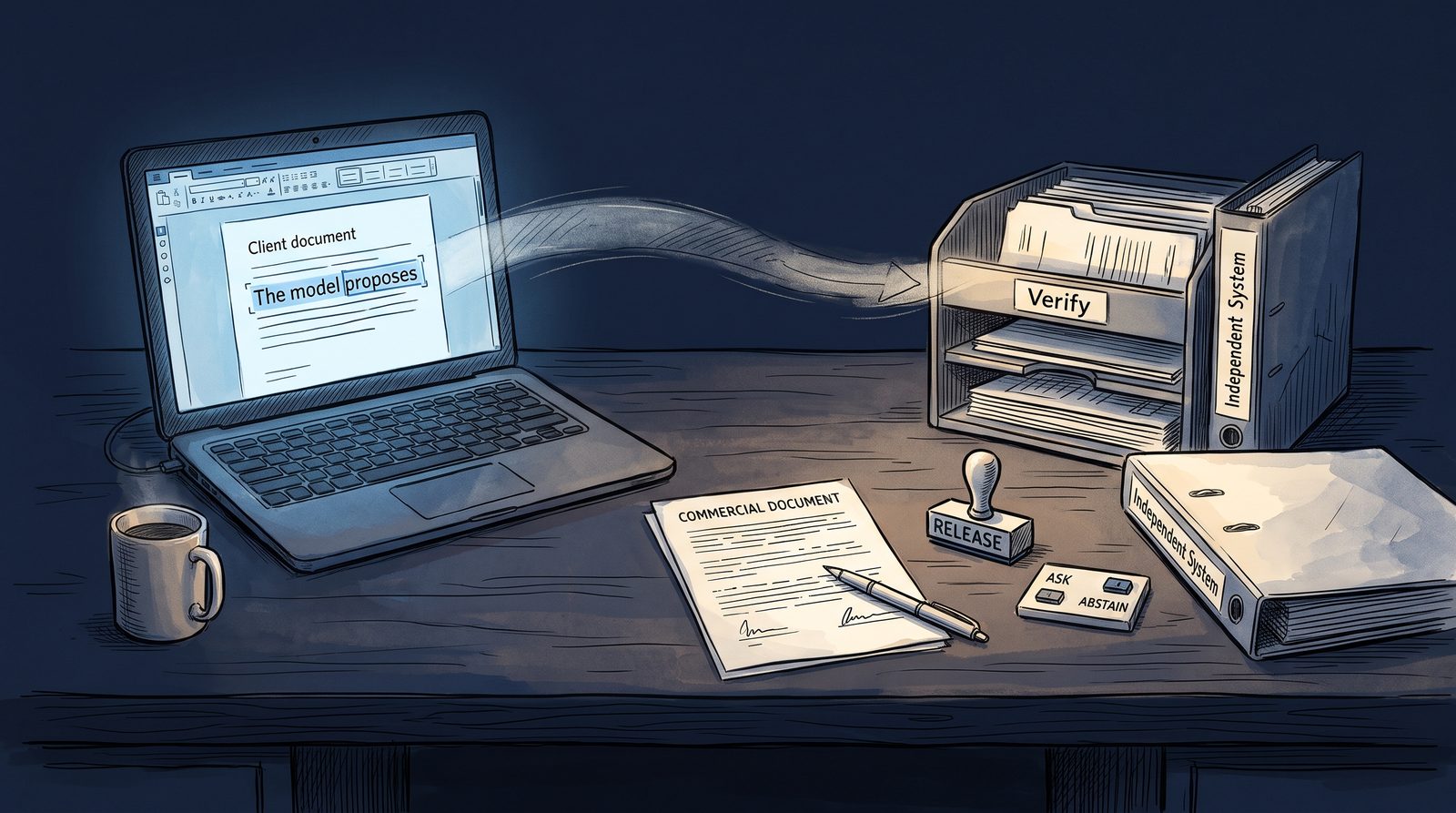
The Heuristic: The model proposes; an independent system certifies.
Never treat fluent language as operational standing. Never ask an AI "Are you sure?"—that only buys a polished performance of confidence.
Before any AI output touches a client, a contract, or capital, enforce a single operational test:
"What independent record proves this claim, and can a second person verify it outside of this chat window right now?"
- If the authority is an external system of record (a database, an exact calculation, or a primary document), mark it RELEASE.
- If one specific input is missing to confirm it, mark it ASK and retrieve the fact.
- If the proof lives only inside the model's own text, mark it ABSTAIN.
The machine is never its own witness.
For the mathematical proofs, computability boundaries, and execution harness architectures, see Certified Ignorance: The Machine That Knows What It Cannot Know (Eduardo Perez Denadai, Optimality AI Press, 2026).