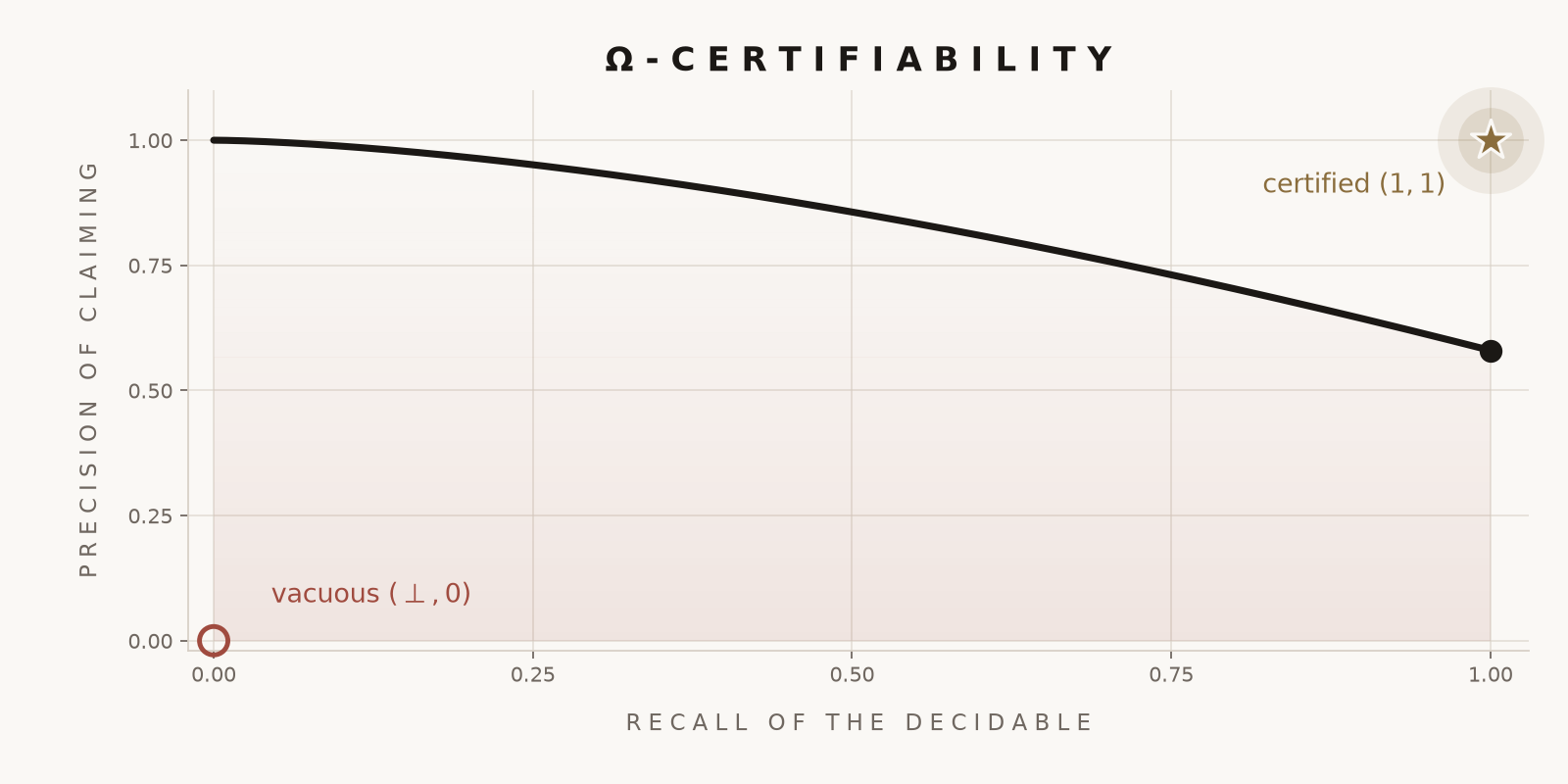
Executive Summary
- The Scalar Blind Spot: Every enterprise model risk dashboard in production today reports a single scalar—96.4% accuracy, a 0.87 "trust score," or a green/amber/red status badge. Each collapses two independent operational facts into one number: what the system claimed and what it refused.
- Mathematical Impossibility: That collapse is not a user-interface flaw; it is an irreducible information loss. A machine-checked enumeration over 924 exhaustive and 80,000 sampled summary functions found zero scalar metrics capable of safely ranking verification systems without concealing risk. A single trust score is a category error, not an executive summary.
- The Examiner's Standard: EU AI Act Article 9, Federal Reserve SR 26-2 (which superseded SR 11-7), and NAIC model governance bulletins do not ask for vendor confidence scores. They require auditable proof of how operational boundaries were set, enforced, and monitored—shifting the regulatory focus from static paperwork to empirical outcomes analysis. The only defensible record is two-dimensional: precision of claiming paired with recall of the decidable, measured against a pinned external authority.
- Actionable Path: This memorandum defines the Two-Dimensional Governance Record, maps its requirements directly to statutory examination standards, and outlines a 90-day implementation path to place an examiner-ready boundary record in front of your regulators.
The Exam Question That Breaks the Dashboard
A supervisory examiner does not ask for your aggregate validation accuracy. She asks a narrower, harder question:
"Show me every high-risk case where the system refused to act—and the deterministic rule that governed the refusal."
A scalar dashboard has no answer because a single number cannot hold a refusal state. Consider two models in credit underwriting or clinical triage that both report 96.4% accuracy:
- Model A answers every request, fabricating plausible outputs at the out-of-distribution tail. Its failures arrive inside confident, well-formatted responses.
- Model B explicitly declines one-third of incoming traffic when required evidence is missing, and is verified correct on nearly everything it releases.
Same headline metric. Opposite risk profiles. Model A is an uninsurable liability engine; Model B is a governed underwriting system. Only the second can survive an audit.
Three Citable Compliance Failures of Scalar Metrics:
- Concealed Operational Liabilities: Unbacked claims (false positives) and unaddressed territory (false abstentions) move the same scalar. A system that quietly fabricates answers on edge cases can report healthy aggregate accuracy until a catastrophic failure surfaces.
- Asymmetric Risk Distortion: Optimizing a single score treats missed opportunities and regulatory violations as interchangeable. In regulated institutions, a missed valid transaction costs margin; an unbacked automated action triggers statutory fines, tort liability, and license risk.
- Lack of Independent Reproducibility: Vendor-supplied "trust" or "confidence" scores are emitted by the very model being evaluated. Under SR 26-2 and EU AI Act conformity standards, risk limits must be re-derivable by an independent third party; self-reported confidence is circular by construction.
When Scalar Confidence Meets Legal Liability: Real-World Precedents
The failure to separate fluent output from verified standing is no longer theoretical. Across courts, regulators, and capital markets, institutions relying on uncontained generative systems have already absorbed binding legal and financial losses:
- Fabricated Legal Citations (Mata v. Avianca, Inc., S.D.N.Y. 2023): Counsel submitted a federal court brief containing six non-existent judicial decisions generated by an LLM. When asked to verify whether the cases were real, the model confirmed they were. Why it happened: A model with no mechanism for refusal converted an epistemic void into fluent continuation, and asking the model to audit its own output merely asked the witness to corroborate himself. Mitigation: Binding the generator to a pinned external legal corpus ($\Omega$) that forces an explicit, auditable refusal whenever a citation lacks a verifiable source.
- Binding Chatbot Misrepresentation (Moffatt v. Air Canada, BCCRT 2024): Air Canada's customer-facing virtual assistant invented a bereavement fare refund policy that contradicted the airline's published tariff rules. The tribunal rejected the carrier's defense that the bot was a separate entity and held Air Canada strictly liable for negligent misrepresentation. Why it happened: Conversational fluency was deployed across a contractual boundary without separating verified corporate policy from generative text. Mitigation: Enforcing $\Omega$-certifiability so no financial or policy commitment can be issued unless verified against an approved policy record.
- Algorithmic Valuation Collapse (Zillow Offers, 2021): Zillow's automated home-buying pricing model continued emitting point-estimate purchase bids across rapidly shifting local housing regimes without a calibrated regime floor or abstention gate, resulting in a USD 500 million inventory write-down and the shutdown of the division. Why it happened: Aggregate in-sample accuracy masked tail exposure as market conditions shifted, and the system lacked a refusal budget to halt automated bids on out-of-regime properties. Mitigation: Partitioning traffic into addressable ($A$) and out-of-scope ($U$) regimes and enforcing hard bounds on overclaim liability.
- Regulatory "AI Washing" Enforcement (U.S. SEC, 2024): The Securities and Exchange Commission fined investment advisers for claiming algorithmic predictive capabilities and automated risk controls they could not substantiate upon examination. Why it happened: Reporting unpinned, self-declared performance metrics without an independent chain of custody. Mitigation: Binding every reported precision and recall pair to a version-locked authority record so examiners can independently verify every disclosed claim.
Why the Failure Is Mathematical, Not a Dashboard Bug
To make AI auditable, separate the proposer ($\pi$, the neural network or LLM) from the authority ($\Omega$, a deterministic, version-locked verification procedure whose soundness is policed). This decoupling maps directly to modern frameworks like SR 26-2, which explicitly carves deterministic rule engines out of probabilistic model governance. Partition the task space into the decidable fragment ($A$, where $\Omega$ can certify a decision non-vacuously) and its undecidable complement ($U$).
Definition ($\Omega$-Certifiability). Measured against a pinned authority $\Omega$, the certifiability of a policy $\pi$ is the two-dimensional pair. Let $\mathrm{claim} \in \{0,1\}$ denote whether $\pi$ emits an affirmative output rather than refusing, and $\mathrm{cert} \in \{0,1\}$ denote whether that output passes $\Omega$'s verification check:
$$ \mathrm{prec}(\pi) = \frac{\mathbb{E}[\mathrm{cert}]}{\mathbb{E}[\mathrm{claim}]}, \qquad \mathrm{rec}(\pi) = \frac{\mathbb{E}[\mathrm{cert} \cdot \mathbf{1}_A]}{P(A)} $$
When the policy makes zero affirmative claims ($\mathbb{E}[\mathrm{claim}] = 0$), precision is $0/0$ and is declared vacuous ($\mathrm{prec} = \bot$, never $1$).
The vacuity rule closes the most common metric-gaming loophole in AI governance. A system that refuses every difficult input scores $(\bot, 0)$: it cannot claim 100% precision on an empty denominator, and its zero recall immediately exposes its lack of operational utility. Conversely, a system that answers every prompt achieves high recall while its precision collapses under out-of-fragment overclaims.
Two Hard Theoretical Ceilings:
- The Statistical Frontier (Chow): Perfect $(1,1)$ certifiability is attainable if and only if decidability is a deterministic function of observed features. Wherever features leave ambiguity, $(\mathrm{prec}^*, \mathrm{rec}^*)$ forms an irreducible Pareto frontier—requiring risk committees to price the trade-off between overclaim and refusal rather than pretending a better model will erase it.
- The Computability Wall (Rice): Predicting whether an arbitrary program or open-ended artifact satisfies a nontrivial semantic property is undecidable in general. Abstention outside a declared fragment is therefore theorem-forced, not a conservative preference.
The Exhaustive Enumeration: The impossibility of a single "AI safety score" is not philosophical opinion—it is a machine-checked result. Across 924 exhaustive candidate summary functions and 80,000 sampled combinations, zero survivors preserved boundary integrity without smuggling hidden institutional risk preferences into a single number [1].
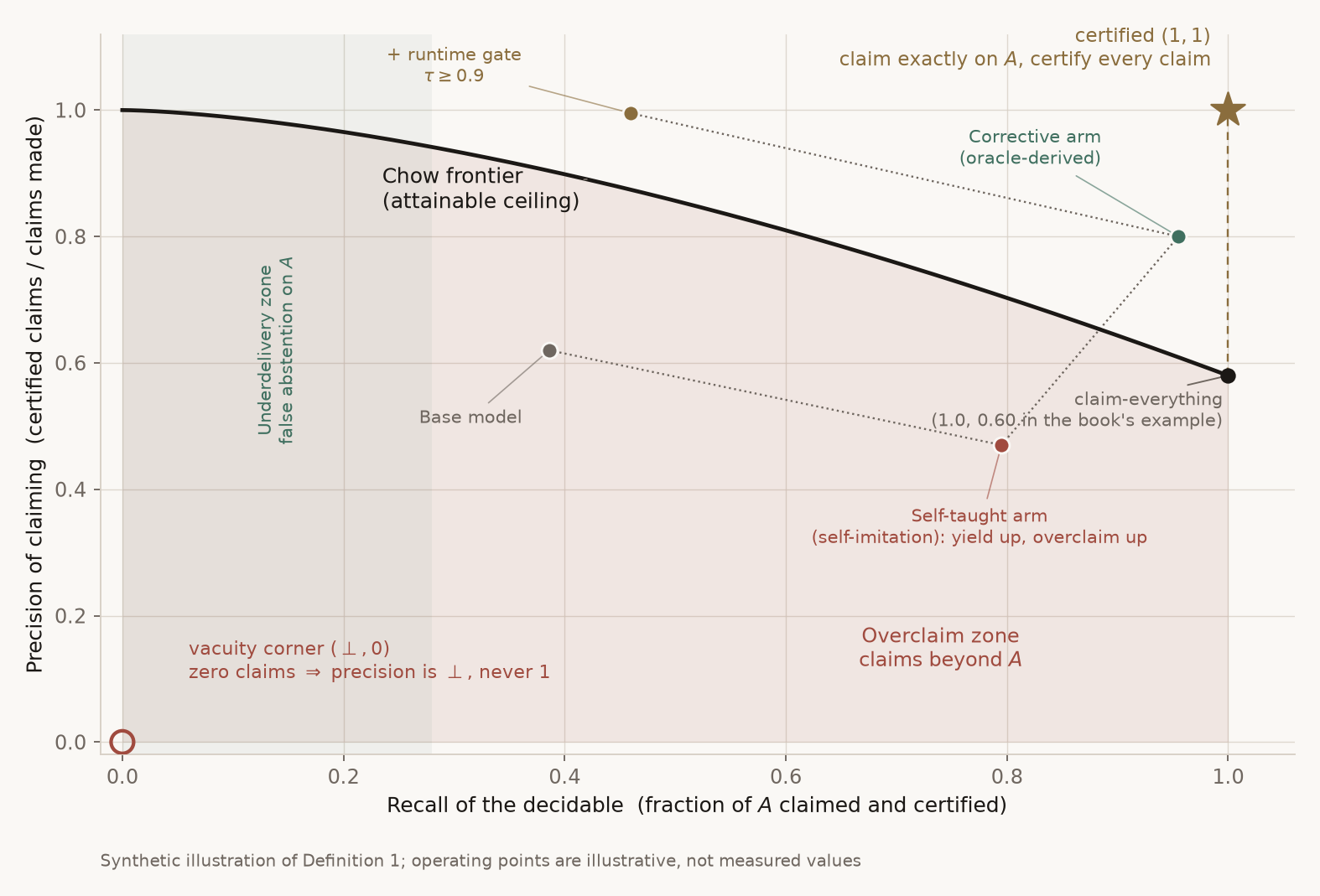
Figure 1 — The $\Omega$-Certifiability Plane. Recall of the decidable ($x$-axis) against precision of claiming ($y$-axis). The claim-everything policy sits at $(1.0, 0.60)$; the abstain-everywhere policy at the vacuous corner $(\bot, 0)$; the shaded band under the Chow frontier is the overclaim zone; the certified target $(1,1)$ is reachable only when decidability is a deterministic function of the input.
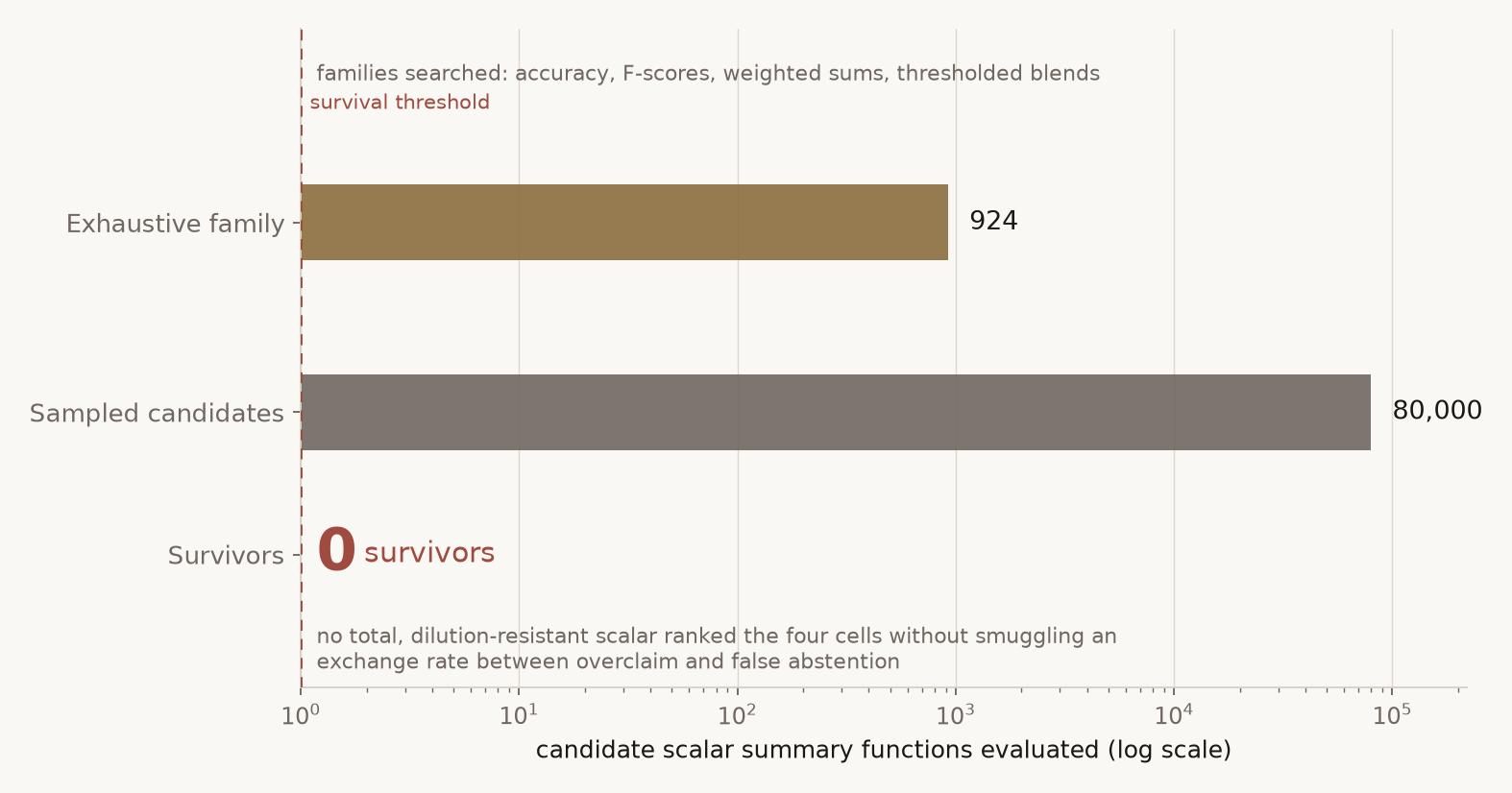
Figure 2 — The Constructibility Search. 924 exhaustive and 80,000 sampled candidate scalar summaries were machine-checked across the standard families (accuracy, F-scores, weighted sums, thresholded blends). Zero survived: no scalar summary of a verification preserves boundary integrity across admissible risk regimes.
Empirical Evidence: Separating Yield from Overclaim
When both axes are measured against a version-locked authority before training, interventions reveal their true risk posture. On a frozen contract-verification benchmark:
| Training / Gating Configuration | Decidable Yield on $A$ | Undecidable Overclaim on $U$ | Audit Interpretation |
|---|---|---|---|
| Base Model (Uncontained) | 38.6% | 58.3% | High baseline liability; answers blindly across voids |
| Self-Taught Arm (Self-Imitation) | 79.5% | 86.7% | Trap: Improves fluency and yield while inflating overclaim |
| Corrective Arm (Oracle-Derived Target) | 95.5% (98.3% replicated) | 30.0% | Moves both axes in the right direction |
| Corrective + Enforcement Gate ($\tau \ge 0.9$) | 46.0% (100% prec.) | 0.0% | Eliminates undecidable overclaim at a priced coverage cost |
Three findings govern compliance design:
- Self-Critique Inflates Risk: Training a model on its own filtered outputs (the self-taught arm) raises decidable yield to 79.5%—making conventional dashboards look better—while driving undecidable overclaim up to 86.7%. Internal self-reflection cannot discover an external boundary.
- Correspondence Drives Grounding: A shuffled-target placebo collapses decidable yield to 1.7% (replicated at 2.8%), proving that boundary learning comes strictly from oracle correspondence, not training pressure.
- Explicit Scope Ceilings: On an unaddressable corpus of 2,148 runtime-state assertions, the measured resolution ceiling was 0 out of 2,148. Reporting zero honestly defines the boundary of static verification rather than fabricating coverage.
Benchmark provenance: the 924/80,000 enumeration is documented in §5 of the companion technical report Ω-Certifiability: A Theory of Certified Ignorance, and the 2,148-assertion corpus in §6; both ship with the Mjölnir ML benchmark suite.
The Audit Artifact: The Two-Dimensional Governance Record
To make model risk legible to boards, auditors, and reinsurers, replace scalar dashboards with a Two-Dimensional Governance Record. Rather than collapsing performance into a single number, it accounts separately for certified claims, unbacked overclaims, and rule-governed refusals.
A defensible governance record establishes six institutional facts for every adjudicated decision:
- Authority Provenance: A cryptographic seal locking the exact rules, policies, and version of the verification authority $\Omega$ in force at the moment of the decision, enabling independent third-party replay.
- Scope Classification: An explicit designation of whether the request fell inside the decidable fragment ($A$) or outside the model's supported operating boundary ($U$).
- Decision Disposition: Whether the system issued a certified release, enforced a rule-backed refusal, or abstained due to missing prerequisite evidence.
- The $\Omega$-Pair: Rolling precision of claiming paired with recall of the decidable—plus the selective claim rate—segmented by business line and risk cohort.
- Vacuity Accounting: An explicit marker whenever a segment makes zero affirmative claims ($\mathbb{E}[\mathrm{claim}] = 0$), preventing operational silence from being misreported as 100% precision.
- Priced Abstention Queue: The operational and opportunity cost of declined in-scope requests, tracked separately from the regulatory and legal liability of unbacked overclaims.
Supervisory & Statutory Crosswalk:
| Regulatory / Standards Regime | Core Mandate | Two-Dimensional Governance Artifact |
|---|---|---|
| Federal Reserve SR 26-2 & SEC/FINRA | Outcomes analysis, materiality-based model limits, and the separation of deterministic rules from probabilistic models | Time-indexed $(\mathrm{prec}, \mathrm{rec})$ evaluated against a version-locked external authority |
| EU AI Act (Articles 9, 12, 14) | Risk management, traceability, and human oversight boundaries | Documented fragment boundaries ($A$ vs. $U$), empirical residual risk ceilings, and per-decision certificates |
| ISO/IEC 42001 & 23894 | AI management system operational controls and risk treatment | Separate accounting for unbacked overclaims versus priced abstention queues |
| SAE J3016 (L1–L4) & ISO 21448 (SOTIF) | Operational Design Domain (ODD) containment and unknown-unsafe mitigation | Deterministic boundary oracle ($\Omega$) gating actuation and enforcing certified refusals outside $A$ |
| ISO 26262 / IEC 61508 & ISO/IEC 24029-2 | Functional safety integrity (ASIL/SIL) and formal neural network verification | Doer-checker architecture separating neural proposer ($\pi$) from formal safety monitor ($\Omega$) |
| NIST AI RMF (Measure/Manage) & FDA PCCP | Reproducible evaluation under shift and strict version-change control | Cryptographic authority pinning with non-pooled reporting across rulebook updates |
Two Non-Negotiable Governance Rules:
- Never pool across authority versions: A pair computed after changing $\Omega$ measures a different rulebook and cannot be averaged with prior periods.
- Never suppress the vacuity symbol: A segment with zero claims must report $(\bot, 0)$—turning silent operational paralysis into a visible governance finding.
90-Day Implementation Path
Days 0–30 — Pin and Partition.
Select one high-consequence workflow with a concrete decidable boundary (such as credit policy eligibility, insurance underwriting rules, or automated financial transaction execution). Freeze the verification authority $\Omega$, record its version seal, partition incoming traffic into in-scope ($A$) and out-of-scope ($U$) cases, and record every decision's outcome against $\Omega$ rather than model confidence.
Days 31–60 — Shadow Boundary Reporting.
Compute the $\Omega$-Pair daily in shadow mode alongside your legacy dashboard. Expect an uncomfortable first reading: models with >95% headline accuracy routinely exhibit >30% overclaim on $U$. Version every policy or boundary update as a new authority seal.
Days 61–90 — Establish Risk Appetite Limits.
Set quantitative floor and ceiling thresholds on both axes with Model Risk Management, price the human-review queue budget with Operations, and elevate the Two-Dimensional Governance Record to quarterly Risk Committee reporting. Retire standalone scalar trust scores from release gates.
Executive Objections & Direct Answers:
- "Our AI vendor already provides a calibrated confidence score."
Ask for the $\Omega$-Pair and the version-locked verification authority behind it. A confidence score without an independent external oracle cannot be re-derived by your validation team and will not satisfy SR 26-2 or EU AI Act conformity assessments. - "Our domain is too complex for a complete formal oracle."
You do not need an oracle for the whole world—only for the narrow boundary where automated execution carries liability. Start with one deterministic rule (eligibility thresholds, jurisdiction limits, or statutory caps) and expand incrementally. - "Refusing edge cases will slow down throughput."
Unverified execution does not eliminate the queue; it moves the queue into legal discovery, regulatory remediation, and financial write-downs. The Two-Dimensional Governance Record prices review capacity upfront so refusal rates remain operationally bounded.
References
- Perez Denadai, E. (2026). Certified Ignorance: The Machine That Knows What It Cannot Know. The Safe Artificial Intelligence Systems Series. ISBN 979-8-1404-9886-3.
- Board of Governors of the Federal Reserve System, OCC, & FDIC. (2026). Revised Guidance on Model Risk Management (SR 26-2 / OCC Bulletin 2026-13 / FDIC FIL-15-2026; superseding SR 11-7).
- European Parliament and Council. (2024). Regulation (EU) 2024/1689 Laying Down Harmonised Rules on Artificial Intelligence (EU AI Act), Articles 9 & 12.
- National Association of Insurance Commissioners (NAIC). (2023). Model Bulletin on the Use of Artificial Intelligence Systems by Insurers.
About Optimality AI
Optimality AI implements AI certifiability for risk-sensitive industries. Whether your systems are built in-house or by external partners, we work alongside Model Risk Management, compliance, and engineering teams to establish verification boundaries and provide independent $\Omega$-certifiability assessments under SR 26-2 and the EU AI Act.
Schedule a Briefing to discuss boundary verification or independent certification for your organization.