Abstract
A verification-centric system guarantees safety structurally: pin an authority, certify execution solely through it, and let an arbitrary proposer only restrict. That guarantee is usually argued on paper. We test it instead on a real substrate — ten continuous-control environments — and we treat every safety test as an attack on the theorem, so that each falsifier names a specific improvement rather than a bug.
The attack succeeds. Across held-out proposers and seven discrete scenarios, a declarative one-step guard certifies actions that end in 27 ego-initiated collisions. Containment (Thm 1) had silently assumed the guard is horizon-sound; a one-step guard is unsound for dynamics with memory. A lookahead guard — a 3-step rollforward under the authority's own dynamics — cuts this to 2 (93%), and the residual is the authority's approximate dynamics model, which is precisely the territory of the next theorem.
We then ask whether a corpus distilled from that authority can transfer. A structural fingerprint cuts certified-search expansions 46.9% within-scenario and 15.4% across; the scenario-identity control collapses to 0% and a shuffled control to 13%, so the key is real — yet the transfer is weak and retention fails. Distilling instead into general typed claims exposes a sharper question: what must "certified" mean? Certified against a trajectory sample, the fragments violated 748 of 5369 held-out checks and the typing control was inert; certified against the authority's reachable set, the same fragments hold with 0 violations on a finer unseen grid, the untyped control collapses to 0 fragments, and the corpus stays sound by construction.
The closure experiments then extend the claim in both directions. Horizontally: the
lookahead guard certified accepted actions only — refutations executed their
fallbacks blind, and 93% of ego-initiated crashes lived on that path; horizon-
certifying the abstain converts every execution into a certified-or-disclosed event and
exposes the abstain wall itself ({SLOWER, IDLE} runs out roughly once per episode).
Vertically: a surgical ablation separates the layers — safety is invariant to
corrupting the rule predicates (+0), the predicates carry competence (14.3pp of
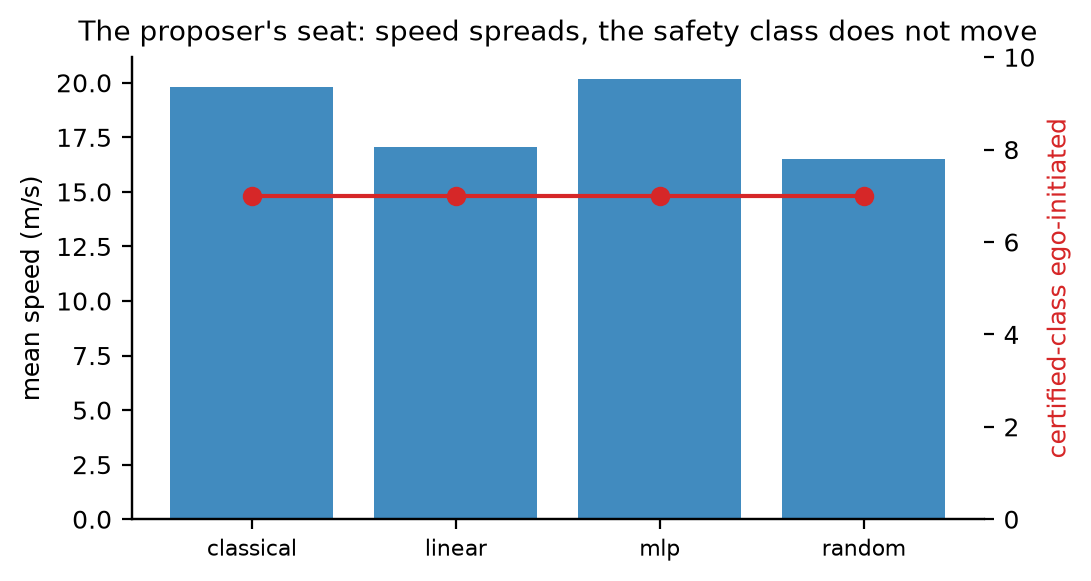
success), and a proposer-quality axis from random to a behaviorally-cloned MLP leaves
the certified safety classes literally identical (7 = 7 = 7 = 7) while speed spans
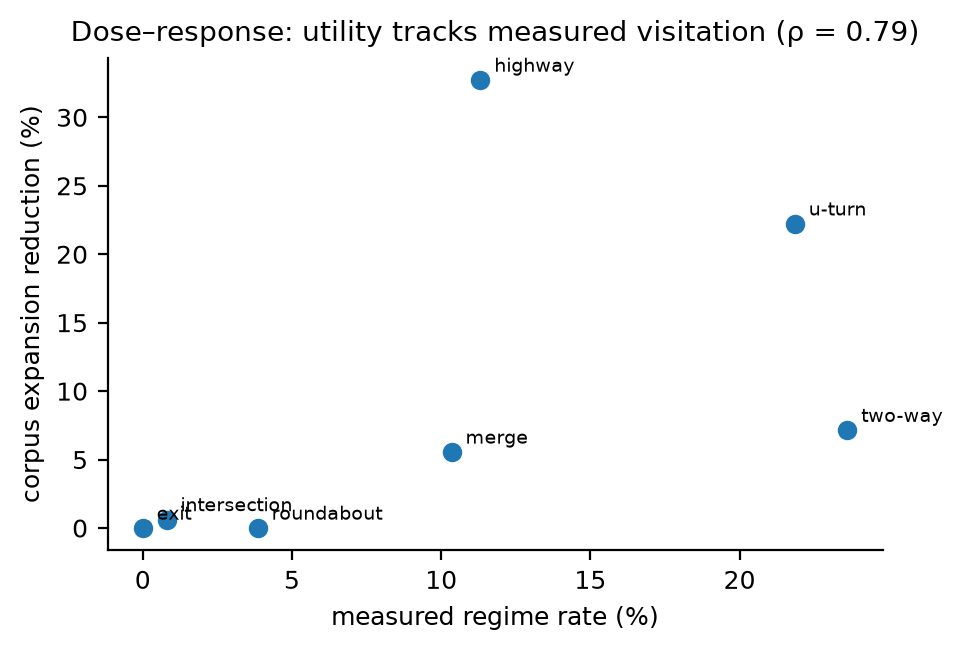
16.5–20.2 m/s. Finally the corpus's missing piece is measured: utility tracks the
substrate's visitation at ρ = 0.79 — the regime is an environment fact,
recorded by the authority, never a frequency the agent predicts. A third substrate then
climbs the ladder's last rung — where the error is intent: a responder model buys
3.4× on the mean error and containment holds perfectly (zero certified contacts), yet
the margin's tail keeps capability hostage until an exact-counterfactual audit shows
the wall certificates are one-sided — margins can certify that an action is safe,
never that none is. Three closing attacks then isolate the abstain path's every defect —
availability, soundness, objective, and finally the margin's magnitude — a scalar at
the error's m99 quantile cannot be sound and feasible at once, naming a
structure-aware (tube) margin as the theorem's remaining obligation. The intent rung
closes without privilege (a motion-only classifier recovers the oracle's error reduction,
accuracy 0.872, recovery 1.20×) and without a canonical spec (the best safety
predicate is regime-relative, and a stricter one raises raw violations) — and
the last component, the runtime monitor, is converted from a failed predictor of
failure (AUROC 0.530, chance) into a checker of the guard's own contracts against the
partial trace (0.797), bounding what monitoring can see: contract-relevant failure
is detectable, exogenous surprise is not.
1. Introduction
This is the fifth paper in a series on the $\Omega$-TD neurosymbolic architecture. The first four established the architecture [1], its belief-space generalization [2], the characterization of its learned components [3], and the theory of certification's cost and the inductive-bias law [4]. This paper applies the framework to a safety-critical domain — continuous control — treating every safety test as an attack on the theorem so that each falsifier names a specific improvement, and it tests whether a corpus distilled from the authority transfers.
The division of labour in a verification-centric system is deliberate: a pinned authority $\Omega$ (deterministic, parameter-free, typed verdict), a proposer $\pi$ that may be a network, a search, or an adversary, and a guard owned by the authority. The proposer's only power is to choose within the guard's admissible set. Under exact evidence channels, a parameter-free guard, and always-available abstention, the proposer cannot leave the safe set for any proposer (Thm 1). Safety is structural, and the programme's theory papers argue it that way.
But a guarantee argued on paper is only as good as its guard, and a guard is a model of the world. Two questions follow, and they are the questions of this paper.
First, does containment hold when the guard is a model of a real environment? Not in the abstract, but in practice: with continuous dynamics, moving obstacles, and a proposer that ignores safety. We answer this by attacking the theorem directly — every safety test is registered as a falsifier before the run.
Second, can knowledge distilled from that authority transfer? A corpus mined from certified searches is only useful if its entries generalize: if a structural key, rather than a scenario identity, drives retrieval, and if the distilled claims are genuinely certified rather than merely observed.
Both answers are partly negative, and the negatives are the point. §3 states the architecture every experiment runs inside and the loop the programme runs. §4.1 reports the falsifier; §4.2 the repair; §4.3 a corpus whose key is real but whose transfer is partial; §4.4 a corpus whose notion of "certified" was wrong and is fixed; §4.5 the abstain path the repair forgot; §4.6 the regime prior that closes §4.4's named next move; §4.7 the ablation that says what carries what — and the proposer's seat; §4.8 prices the model's fidelity in a margin ladder whose last rung exhausts kinematics; §4.9 climbs the rung that remains — where the error is intent — attacks the abstain path four times, removes the responder model's privileged tag, and shows the safety spec itself is regime-relative. §4.10 turns the monitor from a failed predictor into a contract checker, bounding what monitoring can see. §5 states the law all ten results obey — with its regime qualifier — and §6 names what remains open (and what closed).
2. Preliminaries: containment, and the guard that must be sound
Theorem 1 (Containment). If evidence channels are exact, the guard is parameter-free, and abstention is always available, the proposer cannot leave the safe set — for an arbitrary proposer.
The premise that carries Theorem 1 is easy to read past: the guard must be sound — that is, $\mathrm{guard}(s,a)=1$ must imply no violation follows from taking $a$ at $s$. For a memoryless system this is a pointwise condition. For dynamics with memory it is a condition on the trajectory, and a guard that checks one step does not satisfy it. §4.1 shows what that costs.
There is a second place the premise hides: the abstain path. When the guard refutes a proposal it executes a fallback, and the premise "guard refutes → safe fallback" needs the same horizon-soundness as acceptance — the fallback is an executed action too. §4.5 shows what happens when it is not verified: 93% of ego-initiated crashes under the repaired guard lived on unchecked fallbacks.
We instantiate the authority over ten highway-env scenarios with declarative,
physics-derived predicates (gap, ttc, lane, bounds) and a proposer that is
uniformly action_space.sample() — no per-scenario tuning. All ten run end to end
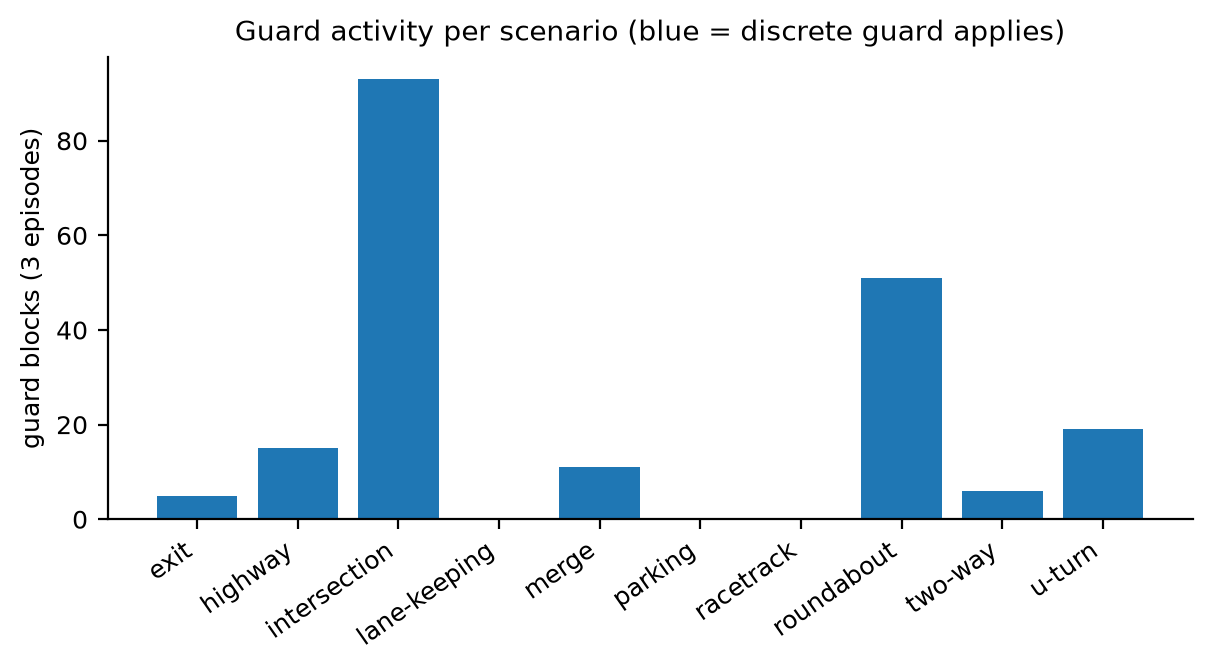
(Table 1); the discrete guard is active on seven, and the continuous scenarios are recorded
honestly as having no discrete guard.
| scenario | action | steps | guard blocks |
|---|---|---|---|
| intersection | Discrete(3) | 134 | 93 |
| roundabout | Discrete(5) | 152 | 51 |
| u-turn | Discrete(5) | 51 | 19 |
| highway | Discrete(5) | 116 | 15 |
| merge | Discrete(5) | 40 | 11 |
| two-way | Discrete(5) | 29 | 6 |
| exit | Discrete(5) | 50 | 5 |
| parking / racetrack / lane-keeping | Box | 159/180/180 | — (continuous) |
Table 1. The substrate (scenarios.json). The guard fires most where interaction is
densest.
3. Method: treat the safety test as an attack
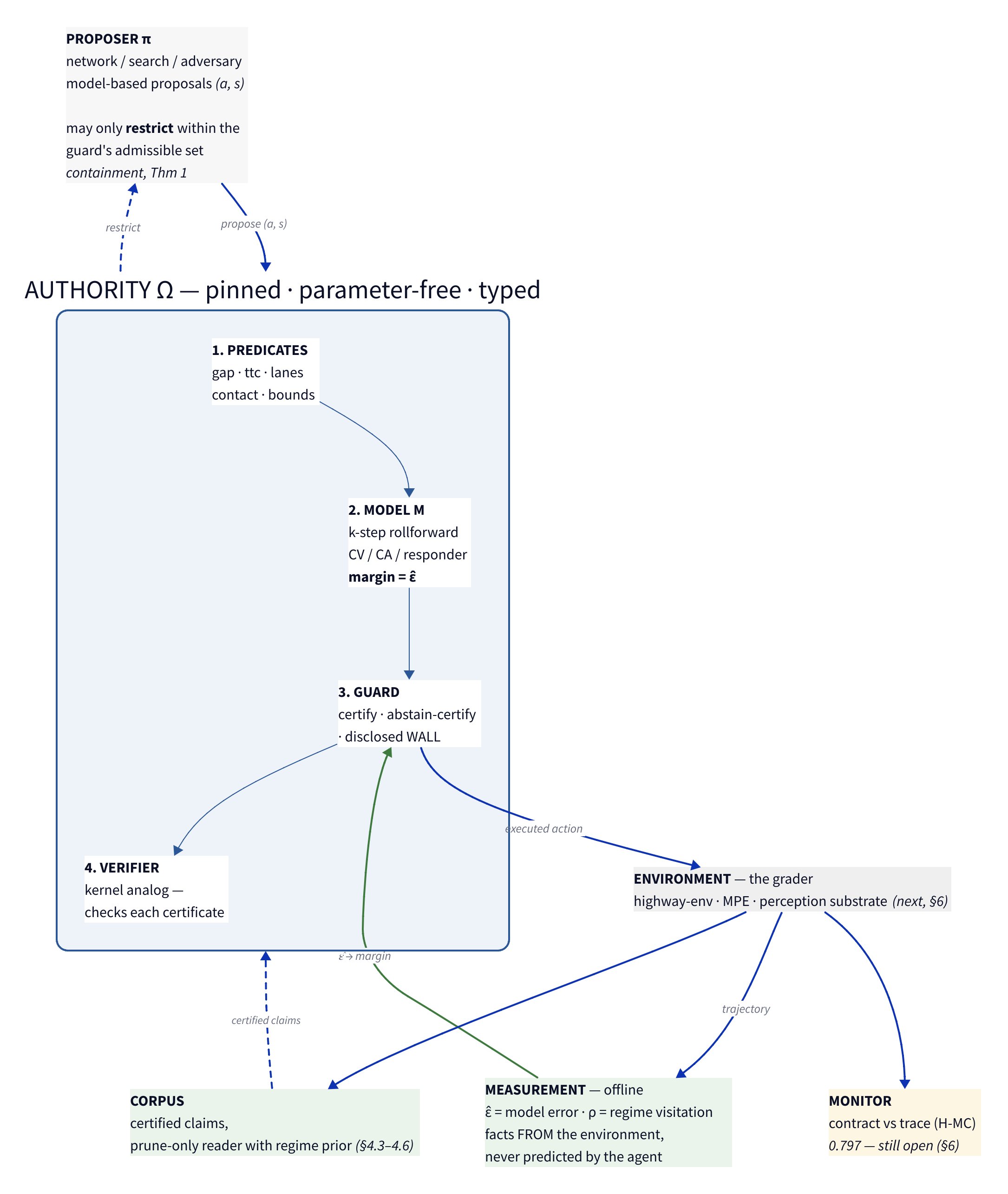
The architecture under attack. Every experiment in this paper runs inside one
architecture — the Ω-TD structure the series established [1] — and it is worth stating
once, precisely, because each falsifier in §4 lands on a named component of it
(Figure 19). The division of labour is asymmetric by design. On the untrusted side,
a proposer π — a network, a search, or an adversary — proposes state–action pairs; its
only power is to restrict within the guard's admissible set. On the trusted side
sits the pinned authority Ω: parameter-free and typed, it comprises (1) predicates
(gap, ttc, lane, contact, bounds), (2) a model M — a k-step rollforward
whose orders are the substrate's choice (constant velocity, constant acceleration,
responder) and whose measured error ε̂ sets the margin, (3) a guard — certify,
abstain-certify, or disclose the wall — and (4) a verifier, the kernel analog that
checks each certificate. The environment is the grader: highway-env here,
PettingZoo MPE in §4.9, a perceptual substrate next (§6). Offline measurement
supplies the two quantities the authority records but never predicts: the model error
ε̂ (§4.8) and the regime visitation ρ (§4.6). A runtime monitor that checks contracts
against the trace (H-MC: AUROC 0.797, §4.10), and the corpus is
the prune-only reader over certified claims, annotated with the measured regime prior
(§4.3–4.4).
Two invariants make this structure Ω-TD rather than a guard bolted onto a policy:
- Containment (Thm 1): the proposer may only restrict. The guard owns safety; the proposer owns speed.
- Soundness is priced by the model (Thm 5): every guarantee traces to M. Margin = measured ε̂ converts an approximate model into bounded containment, and capability tracks fidelity exactly (§4.8).
And one loop runs through every experiment in the paper:
attack the theorem → the falsifier lands on a component of Ω → strengthen that component → measure the new price (ε̂, ρ) from the environment, never from the agent.
Nothing in §4 is an isolated experiment; each section is one turn of the loop. §5 collects those turns, row by row, in Table 17 — the registered falsifier, the component of Ω it named, the component's measured price after repair, and the section that reports it — where the law that all of them obey is stated.
We register the safety suite as falsifiers before running it: held-out proposers (GS-1), a forced-motion regime with no static abstain (GS-2), the authority's fidelity (GS-3), adversarial others (GS-4), and cross-environment invariance (GS-6). A collision is ego-initiated if the ego was moving and the contact partner lay ahead of its heading — the guard's failure — and other-initiated otherwise — the model's gap. This attribution is a documented geometric heuristic, and we say so (§6).
The corpus experiments follow the same discipline: a shuffled control to test whether the
key is real, a scenario-identity control to test whether it is a lookup table in disguise,
and a finer held-out grid to test whether a certified claim is general. The closure
suites — the four original bars operationalized (H-1..H-6), the regime prior, the surgical
predicate control, the proposer-quality axis, and the abstain repair — were registered as
substrate addenda (H-ORE, H-RP, H-SC, H-PQ, H-6-D, H-S3, H-PQ2) before their runs, and
the paper's own section/figure set was registered in paper_safety/PLAN.md before the
figures were generated. Every bar is registered before its run, and failed bars are
reported where they occurred.
4. Results
4.1 The attack succeeds: containment fails for a one-step guard
The falsifier fires. Across three held-out proposers and seven discrete scenarios, the declarative guard certifies actions that end in 27 ego-initiated collisions against a registered bar of 0 (Table 2). It fails in every scenario (two-way 9, merge 6, u-turn 4, highway 3, exit 2, intersection 2, roundabout 1), and an adversarial stopped hazard makes it worse (GS-4: 7). The forced-motion regime does not fire the abstain wall (GS-2: 0), and five collisions are other-initiated (GS-3).
| proposer | ego-initiated | …of which pointwise | other-initiated |
|---|---|---|---|
| random | 14 | 5 | 0 |
greedy (FASTER) |
8 | 7 | 2 |
| swerve (lane changes) | 5 | 3 | 3 |
| total | 27 | 15 | 5 |
Table 2. GS-1 (safety.json). The bar was 0; observed 27. Reported, not moved.
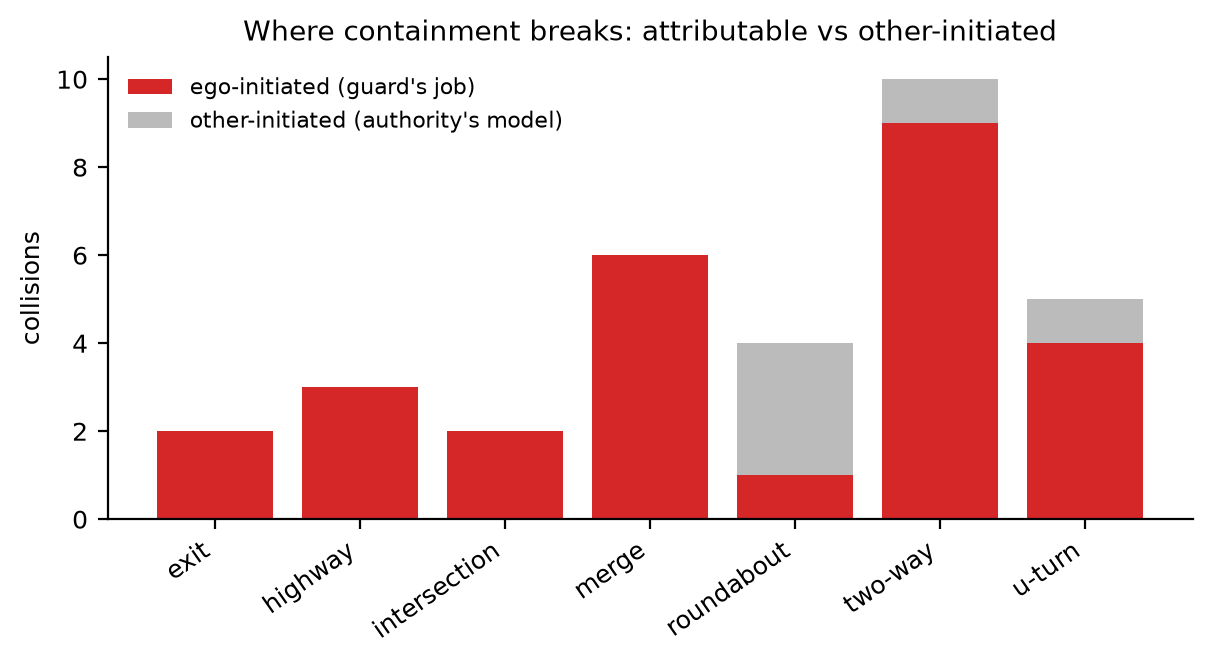
The defect is diagnosable, and the diagnosis lands on the theorem rather than the code: the 27 split into 15 pointwise (the guard's own thresholds certify an action that is already unsafe at the collision state) and 12 horizon (each step is locally safe; the trajectory collides). A one-step guard is unsound for any dynamics with memory. The safety boundary is the authority's model — its horizon, thresholds, and dynamics — not the proposer.
4.2 The repair: a horizon-sound guard, and the residual it names
The fix the falsifier demands is not more conservative thresholds but a longer horizon: a lookahead guard that certifies an action only if a $k$-step rollforward under the authority's own dynamics (ego acceleration, lateral lane-blend; others constant-velocity) is collision-free. It cuts ego-initiated collisions from 27 to 2 (93%), and the adversarial-hazard case from 7 to 1 (Table 3, Figure 6).
| one-step guard | lookahead ($k{=}3$) | |
|---|---|---|
| GS-1 ego-initiated | 27 | 2 |
| GS-4 (adversarial hazard) | 7 | 1 |
| GS-3 other-initiated | 5 | 2 |
Table 3. The horizon-sound guard (safety.json, LA-*). The strict bar was 0,
observed 2 — reported FAIL, not moved.
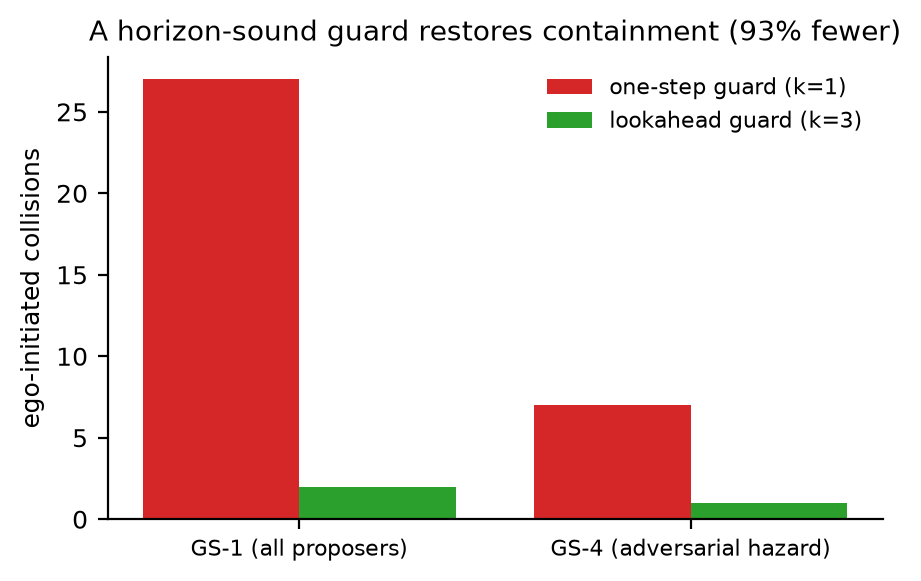
The residual is the scientifically interesting part. Two ego-initiated collisions survive — 1 pointwise, 1 horizon — and they are the dynamics model's own error, not the proposer and not the horizon. That is exactly the territory the next theorem must formalize: containment under an approximate authority. The loop is closed: falsifier → diagnosis → theory correction → mechanism → residual names the next theorem.
Robustness (the correction ledger). A wrapper defect found later — the pointwise
layer's tau argument was silently receiving v_min, leaving the headway predicate
inert in every lookahead run — means the original lookahead arm was effectively a
rollforward-only guard. The corrected re-run (τ active) reproduces the numbers exactly:
27 → 2 in both, and re-enabling the pointwise layer flips 0 of 987 decision
states. The spine is not an artifact of the defect; the rollforward alone carries the
fix. As-run and corrected artifacts are both preserved (results/*_astau0.json), and the
defect class is locked by a unit test.
4.3 A corpus distilled from the authority: real key, partial transfer
Efficiency, not safety, is where learning enters. A corpus entry is
fingerprint(situation) → (certified action, cost), mined by the authority's search,
stored by structural similarity of local geometry, and re-verified on use — so a bad
retrieval wastes work but cannot loosen the guard. We measure transfer with a paired
protocol: one trajectory driven by the cold search, and at every decision both the cold cost
and the cost the corpus would have incurred.
| target | cold | with corpus | reduction |
|---|---|---|---|
| highway (within) | 339 | 180 | 46.9% |
| merge | 34 | 27 | 20.6% |
| exit | 180 | 180 | 0.0% |
| two-way | 29 | 24 | 17.2% |
| u-turn | 54 | 27 | 50.0% |
| intersection | 161 | 154 | 4.3% |
| roundabout | 72 | 72 | 0.0% |
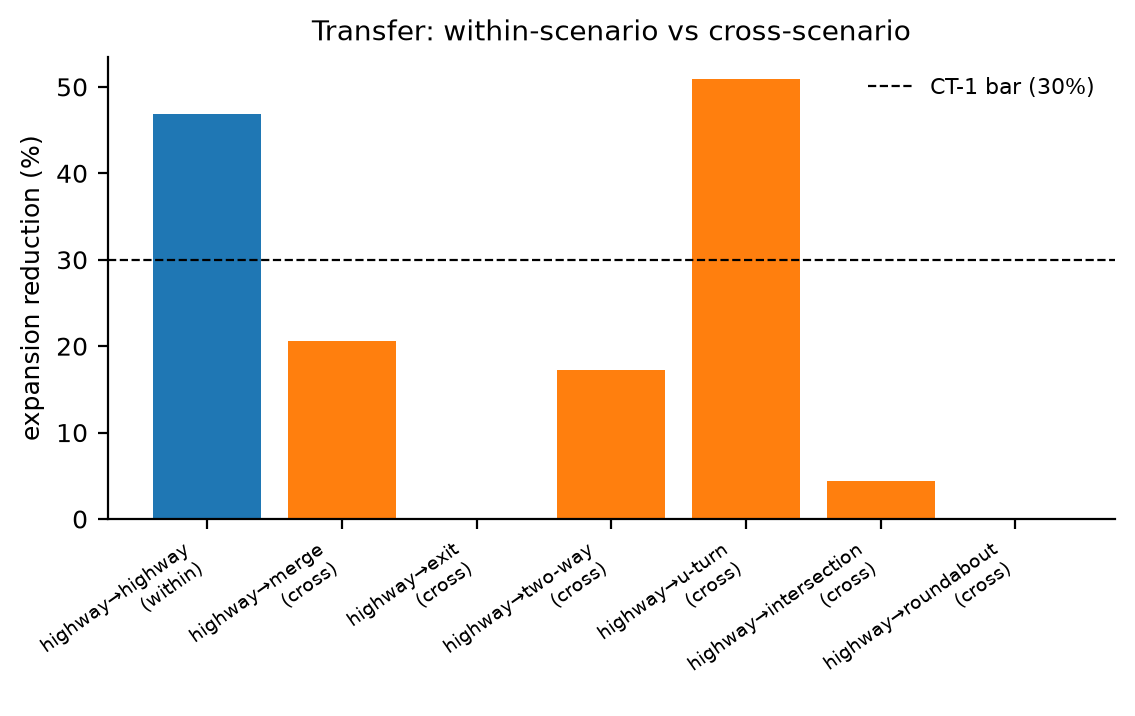
Table 4. CT-1 (transfer.json): within 46.9%, cross mean 15.4% (bar 30%) — FAIL.
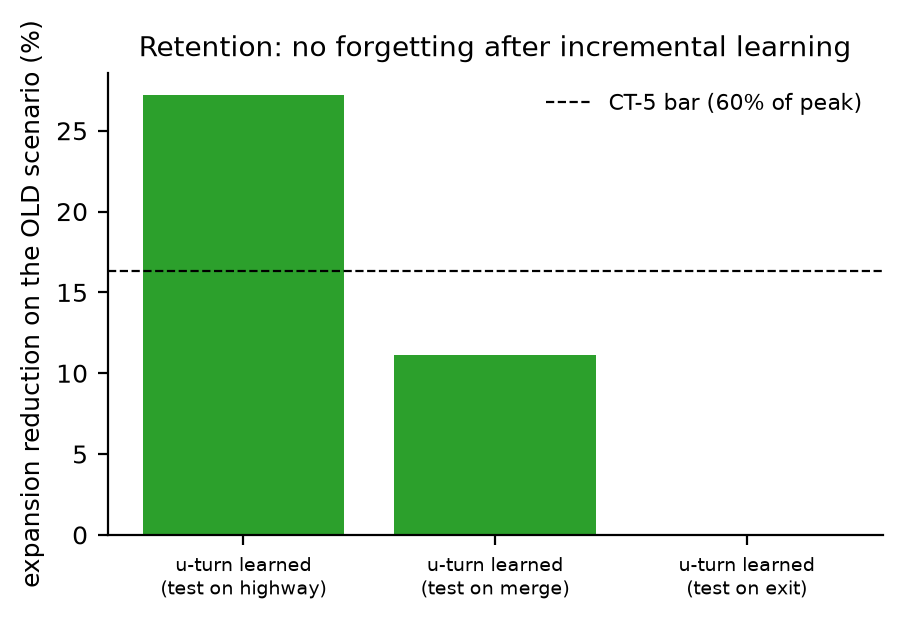
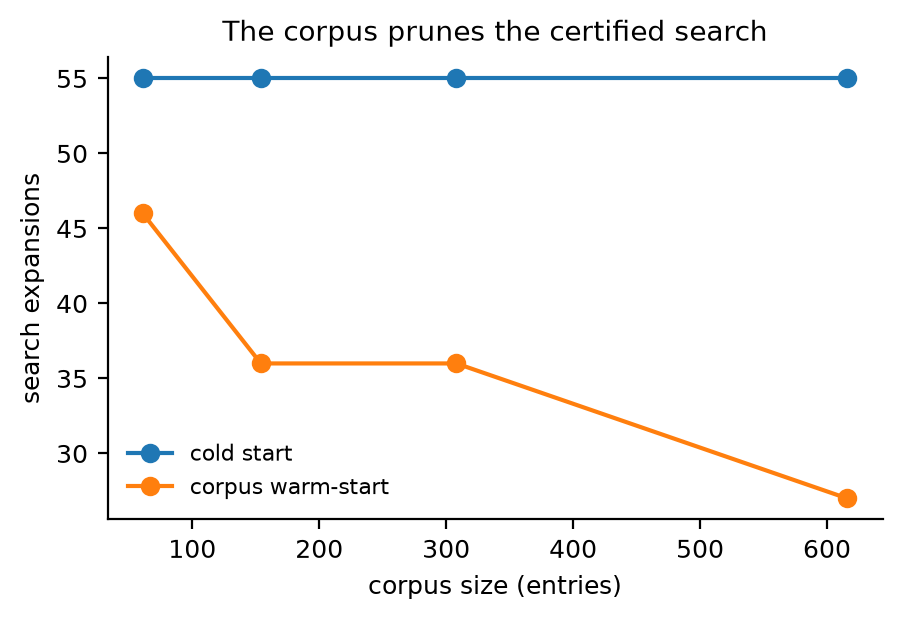
The key is real and structural: on u-turn, where the relational fingerprint reaches 50%, the scenario-identity control collapses to 0% and a shuffled control to 13%. It is sound by construction — the corpus adds 0 ego-initiated collisions beyond the verifier's own residual (CT-2: corpus 13 = cold 13) — and its benefit grows with size (14.8% → 50.0%). But retention fails (highway 27.2%, merge 11.1%, exit 0.0%): the accumulated corpus dilutes rather than accumulates. It is a within-scenario accelerator, not yet a general method.
4.4 What "certified" must mean: the distilled corpus
The proper form of a corpus is not a lookup of situations but general, typed statements distilled from what the agent is exposed to — the miner a proposer, the authority's lookahead guard a verifier, and the reader a consumer that prunes (it may only restrict, never authorize). Certified over the authority's reachable set, the corpus is, in the kinematics exposure (30 fragments) and the geometry exposure (4):
| distilled claim | verdict | support |
|---|---|---|
gap < 8 |
UNSAFE(FASTER) | 120 |
ttc < 2 |
UNSAFE(FASTER) | 112 |
ttc < 2 ∧ closing > 0 |
UNSAFE(FASTER) | 112 |
ttc < 0.5 |
UNSAFE(FASTER / SLOWER / LANE_LEFT / LANE_RIGHT) | 24 each |
dx < 10 |
UNSAFE(FASTER) | 72 |
Table 5. The distilled corpus (fragments_library.json, representative rows). These are
the general statements one wants: slow down on an obstacle, and at imminent collision no
discrete maneuver helps.
The scientific question is what "certified" has to mean for such a claim to be general. Certified against a trajectory sample, the fragments failed: 748 violations in 5369 held-out checks, and the untyped control (features shuffled) did not collapse — a statistical claim wearing a certificate. Certified instead against the authority's reachable set (a systematic grid, every cell labelled by the guard), both defects fall together:
| bar | sample-certified | model-certified |
|---|---|---|
| typing control (untyped vs real) | FAIL (20.4% > 13.0%) | PASS — untyped → 0 fragments, 0.0% |
| generality (held-out) | FAIL — 748 violations | PASS — 0 violations / 183 checks |
| soundness (added collisions) | PASS | PASS (−3) |
| transfer (cross-scenario) | FAIL (8.4%) | FAIL (8.0%) |
Table 6. One fix — certify against the model, not a sample — closes the epistemic defects.
The remaining residual is principled, not a defect. A claim like
ttc < 2 ∧ closing > 0 → UNSAFE(FASTER) is true everywhere (0 violations on a finer
unseen grid) but only fires when that situation arises — often in merge/u-turn, rarely in
exit/roundabout. Generality of the claim ≠ generality of the benefit. The next move is
not a stronger certificate but a regime prior — and its source is the environment,
not the agent: how often a condition arises is a fact of the substrate's visitation
distribution, measured by the authority from logged rollouts and frozen with the
corpus. The reader consumes that measured prior only to order retrieval (prune-only, so
containment is untouched); it never predicts it, since an agent-side frequency model
would re-introduce, in the weighting layer, the same statistical-claim-wearing-a-
certificate defect the grid certification removed from the condition layer.
4.5 The abstain path must be sound too
The repair in §4.2 certified accepted proposals and nothing else: on any refutation
the guard executed its fallback — normally SLOWER/IDLE — without a rollforward
check, on the strength of Thm 1's premise that the fallback is safe by construction.
Classifying every crash by the status of the executed action shows where that premise
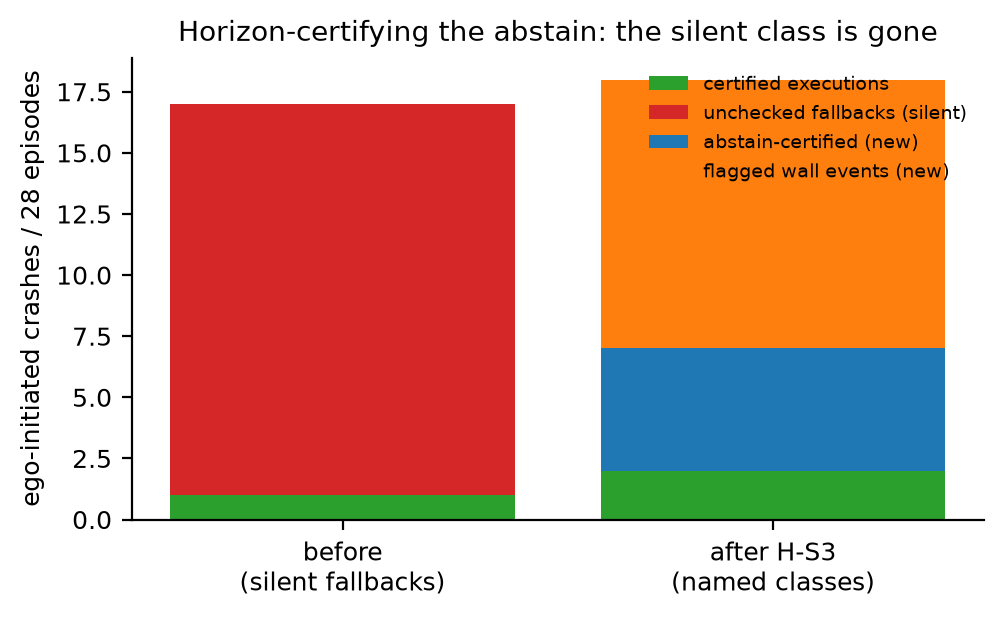
actually lived: of 74 ego-initiated crashes across the proposer experiments, 69 (93%)
were on unchecked fallbacks; only 5 were on certified actions — the Thm-5 residual of
§4.2. The certified-only metric of GS-1 was correctly scoped and therefore could not see
this class at all.
The correction is the same shape as §4.2's: horizon-certify the abstain. On a
refutation, each registered abstain candidate (SLOWER, subject to v_min; IDLE) is
rollforward-certified against the true state, and the first that certifies executes. If
none certifies, the execution is a flagged wall event — a disclosed blind
execution, never a silent one. The mechanical guarantee (only kind="wall" returns are
unchecked) is locked by a unit test; across the run, 325 abstains certified and 20 walls
fired, with zero silent blind executions.
The measured outcome is honest and negative where it matters (Table 7): the wall fires
roughly once per episode — within {SLOWER, IDLE} the constant-velocity rollforward
frequently finds no safe action at speed — and the crash total does not move (18 → 18).
The registered bars fail exactly as their fail-clause prescribed: the abstain set must
grow. The taxonomy is now complete:
| class | count / 28 eps | meaning |
|---|---|---|
| proposal-certified | 2 | the Thm-5 residual (§4.2) — unchanged |
| abstain-certified | 5 | the rollforward certified slow/coast and reality disagreed: Thm 5 on the abstain path |
| wall (flagged) | 11 | the model predicted collision for every candidate: the H-5 abstain wall, measured |
Table 7. H-S3 (abstain.json, random arm): SB-1 wall ≤ 2 FAIL (11), SB-2 broad
≤ 4 FAIL (18), SB-3 success ≥ 0.60 FAIL (0.357). Certification changed
accounting, not outcomes — and the accounting is the point: every crash now has a
named cause, and the next mechanism (a grown abstain set with lane-change escapes,
H-S3b) is prescribed by the fail-clause rather than guessed.
4.6 The regime prior, measured
§4.4 ended with a named next move: a claim's benefit depends on how often its condition arises, and the frequency is an environment fact. H-RP measures it. A calibration pass on each target substrate records, for every certified fragment, the fraction of its own decision states where the condition holds — the visitation rate, measured, not predicted — and the reader consumes that prior only to order retrieval (prune-only, re-verified: containment untouched). Four registered bars, all passed:
| bar | claim | observed |
|---|---|---|
| RP-1 | dose–response: reduction tracks the measured regime rate, ρ ≥ 0.7 | ρ = 0.793 (7 scenarios) |
| RP-2 | a prior measured on a different scenario retains strictly less | target 163% vs mismatched 146% |
| RP-3 | top-50% by measured firing rate retains ≥ 90% at ≤ 50% of the checks | 163% at 50% |
| RP-4 | the prior-ordered reader adds zero ego-initiated | −2 (11 vs cold 13) |
Retention above 100% is a real effect, not an artifact: a low-firing fragment can prune an action that would have certified first, costing an expansion — dropping claims that rarely arise removes those harmful prunes. The corpus half of the paper is therefore closed on its own terms: generality of the claim ≠ generality of the benefit — and the benefit is recovered by measuring where the claim arises (Figure 8).
4.7 What carries what — and the proposer's seat
Two registered suites separate the layers the law talks about. First, the grounding ablation: swapping the rule-predicate thresholds for hand-tuned ones changes nothing (hand ≡ derived, 35.7% = 35.7%), which fires H-4's registered ENGINEERED falsifier (VOID) — and a surgical control then attributes why. Corrupting only the predicate view while feeding the rollforward true state collapses success by 14.3pp, versus 17.9pp when both layers are corrupted: the predicates drive ~80% of the performance collapse, the dynamics inputs ~3.6pp — while safety is invariant to predicate corruption (+0/−1 ego-initiated, SC-2). Combined with §4.1's three-arm ablation (predicates alone: 27 breaches; rollforward alone: 2; both: 2), the split is clean:
- safety = the dynamics model + horizon check (predicate corruption cannot break it; predicates alone cannot provide it);
- competence = the rule predicates (14.3pp of survival under surgical corruption);
- speed = the proposer's seat.
The handshake confirms the composition from below (guarded 35.7% vs unguarded raw 16.1%, +19.6pp), and the proposer-quality axis tests the seat from above. A behaviorally-cloned proposer (logistic regression, then a 64-unit MLP, teacher = the authority's own certified search) joins random, a fixed reflex, and a hand-coded progress policy, all under the guard. PQ-1 failed at small capacity — the hand policy beat learning by 3.6 m/s — and its follow-up shows both axes: with 4× data the linear model barely moves (0.639 → 0.665 agreement) while the MLP 0.745 (bar 0.80: the features are binding, not the capacity), and the MLP earns the speed seat: 20.16 ≥ classical 19.81 m/s (PQ2-1 PASS). Meanwhile the safety side does not move at all (Figure 10):
| arm | mean speed | certified-class ego |
|---|---|---|
| random | 16.51 | 7 |
| classical (hand) | 19.81 | 7 |
| linear (BC) | 17.04 | 7 |
| MLP (BC) | 20.16 | 7 |
Table 8. H-PQ2 (capacity.json): certified-ego is literally identical across
proposers of every quality while speed spans 3.7 m/s. The bar of 4 fails as
registered (7 > 4) — decomposed, the excess is the abstain-certified Thm-5 class of
§4.5, not certification failures (0–2, proposer-invariant); a future registration
should split the classes. The containment claim underneath is the strongest in the
program: quality changes speed; the safety classes do not move.
A third registered bar tests the theory paper's bias law directly on the driving predicate (H-6). Three candidate orderings for the certified search, scored at the same decision states: the hand-coded speed-first order (classical, 1.393 mean expansions), a relaxation ranked by the authority's own kinematic predicate (matching, 1.420 = 1.02×), and a frozen-leader gap model that ignores closing speed (local, 1.672 = 1.20×). The registered claim — matching crosses the f-contour at ≤ 1.0× where local does not — FAILS: local fails to cross as predicted, matching clearly beats local, but the relaxation misses the ≤ 1.0× bar. Reported, not moved; §5 explains why the aggregate was the wrong object to test.
4.8 Containment under an approximate authority: the margin, the ladder, and where the error lives
What remains after §4.5 is a fixed, named quantity: the certified classes — 2 proposal-certified plus 5 abstain-certified collisions per 28 episodes, all of them actions the guard approved and the world refuted. They are the dynamics model's error, and they are Thm 5's empirical content. The registered question is whether the theorem can be bought the honest way: measure the model's error from the substrate itself, and certify only with a clearance margin equal to it.
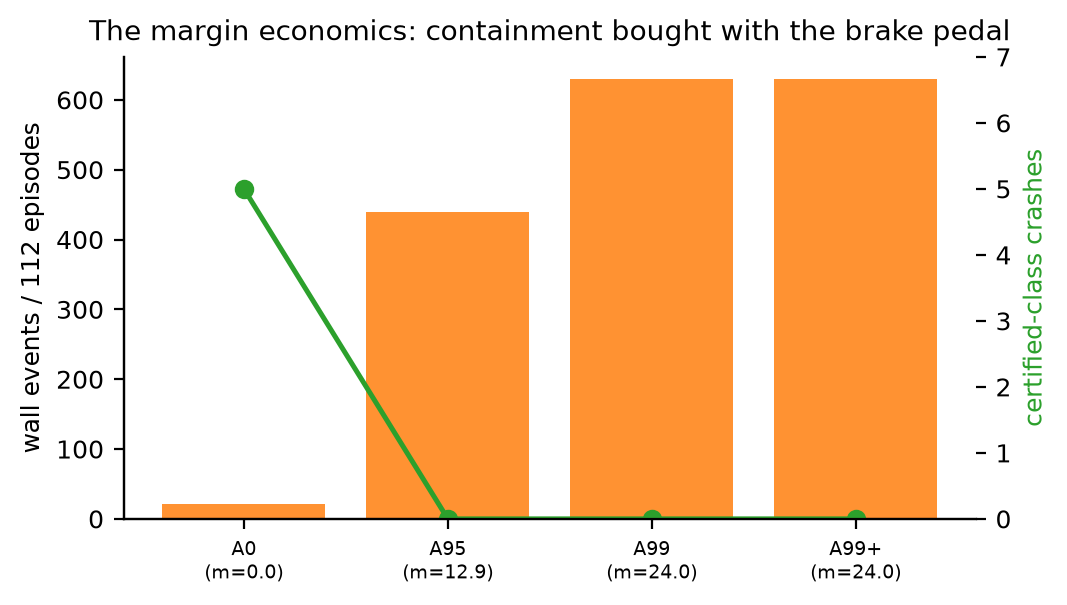
The mechanism and the quantity. The margin widens the rollforward's collision box at every horizon step — for proposals and abstain candidates alike, since §4.5 showed the abstain path is an executed action too. The error is measured, not assumed: on calibration trajectories, the authority runs its own model (ego kinematics under the executed action, others constant-velocity) and compares the predicted relative position against the real one at each horizon check time; the per-state error is the worst pair's maximum over the horizon. The measured distribution (2305 samples): mean 4.91 m, m95 12.87 m, m99 23.98 m, max 141.73 m — a heavy-tailed quantity, because the tail contains lane swings and spawn events a point model cannot represent at all.
The result — containment, bought with the brake pedal. The margin works as the theorem predicts and fails as a product (Table 9, Figure 11): at m = m99 the certified classes go to 0 (T5-1) — but a 24 m clearance box intersects someone at nearly every step in dense traffic, so the guard fires 630 wall events per 112 episodes and almost every execution is a flagged blind fallback. The abstain set cannot help: even lane changes cannot certify through a 24 m box, so the grown set is inert (A99+ ≡ A99). And the wall itself does not yield — wall-class holds at 14 (T5-2, FAIL): even total cowardice cannot abstain safely at speed, because the wall executes its preferred fallback blind. Success rises to 50%, which is the tell: the "guard" has become an emergency brake.
| arm | margin | certified classes | wall-class | wall events | success |
|---|---|---|---|---|---|
| A0 (baseline) | 0 | 5 (1+4) | 13 | 22 | 35.7% |
| A95 | 12.87 | 0 | 13 | 439 | 50.0% |
| A99 | 23.98 | 0 | 14 | 630 | 50.0% |
| A99+ (grown abstain) | 23.98 | 0 | 14 | 630 | 50.0% |
Table 9. H-T5 (thm5.json): the margin restores containment (T5-1 PASS,
degenerate) but pays with capability (T5-2 FAIL; T5-3 PASS trivially — the grown set
is inert at this margin).
The registered fail-clause fires — and it points at the model, not the margin. A scalar quantile must either ignore the tail (unsound) or cover it (unusable); the 141.73 m outlier guarantees the two failure modes touch. The error is state-structured, and the obvious response — a model with less error — was itself registered as the next bar (H-T6): the same protocol, only the dynamics model swapped, with the two models' errors measured paired on the same trajectories.
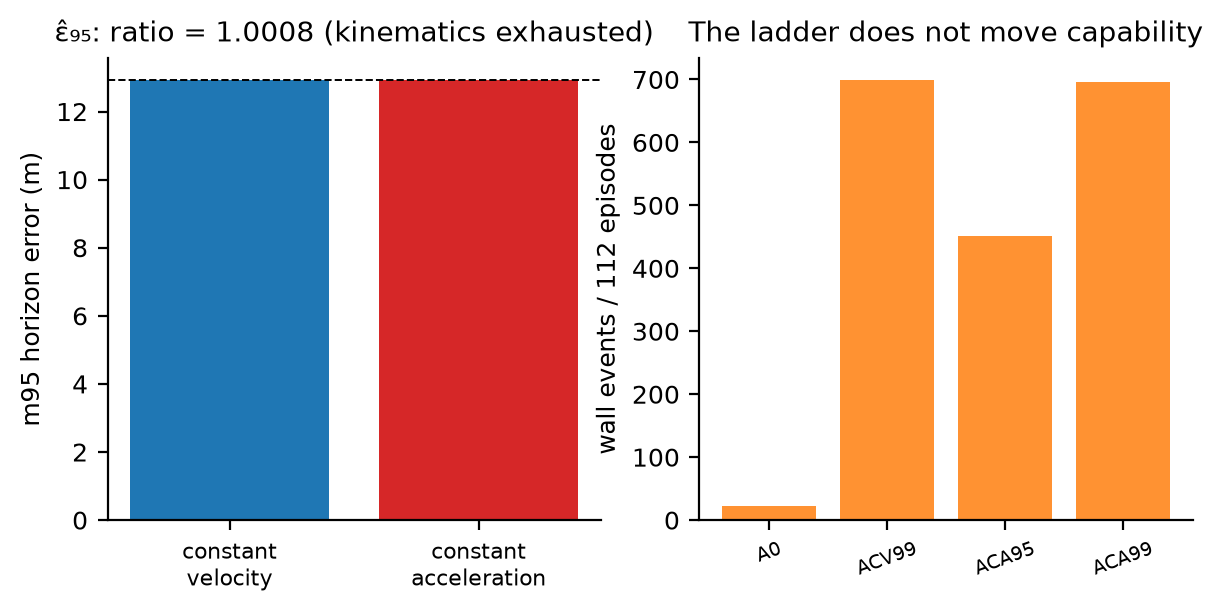
The ladder: kinematics, exhausted in one rung. The constant-acceleration model (each other's longitudinal acceleration estimated by finite difference of its observed speed, extrapolated under the rollforward) reduces the measured horizon error by nothing: m95 = 12.92 m versus the constant-velocity model's 12.91 m — a ratio of 1.0008 (Table 10, Figure 12). Capability follows the error into the wall: 696 wall events against CV's 699, identical certified classes, identical success. The ladder did not move, and the registered reading of that failure is precise: the error is not in the longitudinal acceleration.
| rung | model | ε̂₉₅ | margin | wall events | success |
|---|---|---|---|---|---|
| 1 | constant velocity | 12.91 | 25.64 (m99) | 699 | 50.0% |
| 2 | constant acceleration | 12.92 | 25.55 (m99) | 696 | 50.0% |
| 3 | reactive / intent-aware | — | — | — | — |
Table 10. H-T6 (thm6.json): two kinematic orders, one error. The finite-
difference estimate is lagged relative to reaction — IDM vehicles recompute
acceleration from the evolving gap at every step, so when a leader begins to brake the
estimate still carries the pre-braking value, and the higher-order extrapolation
commits the same error in a different direction. Lateral lane-swing structure adds at
constant scale under held heading.
What the two failures establish together. The model error in interactive traffic is interaction-structured: what cannot be extrapolated is the response — how the others will react to the ego's action and the evolving gaps — and no kinematic order captures a reaction by extrapolation. This gives Thm 5 its final empirical form:
Containment under an approximate authority holds at a clearance margin equal to the model's measured error — and the capability that remains is exactly the model's fidelity. In interactive traffic the fidelity budget is spent on kinematics by rung two; what remains is intent.
The margin protocol itself — measure ε̂ on the substrate, certify at that margin, report the walls — is model-agnostic and survives both runs intact. What must change is the first model on the ladder: not an extrapolator but a responder model, whose uncertainty tube covers plausible reactions. That model cannot be fit on this substrate, where others are scripted: the third rung lives in the multiagent probe, where the other vehicles are agents and "what will they do" is not noise around a trajectory but its cause. The safety arc thus ends where the programme goes next, with its measuring instrument in hand.
4.9 The third rung: containment where the error is intent
§4.8 ended by naming the third rung: the fidelity budget in interactive traffic is
spent on kinematics by rung two, and what remains is intent — which cannot be fit on
a substrate whose others are scripted. This section climbs it, on PettingZoo MPE
(simple_adversary, simple_spread, simple_tag): three agents, force-based physics
with heavy damping, and others driven by known greedy policies — a blocker that
seeks the ego, a runner that seeks the landmarks. Two properties make MPE the right
laboratory: the ego's own dynamics are mirrored from the engine's source to 1e-9
(the physics-mirror test), so ε measures the others only; and the environment is
deterministic with known policies, so counterfactuals are exact.
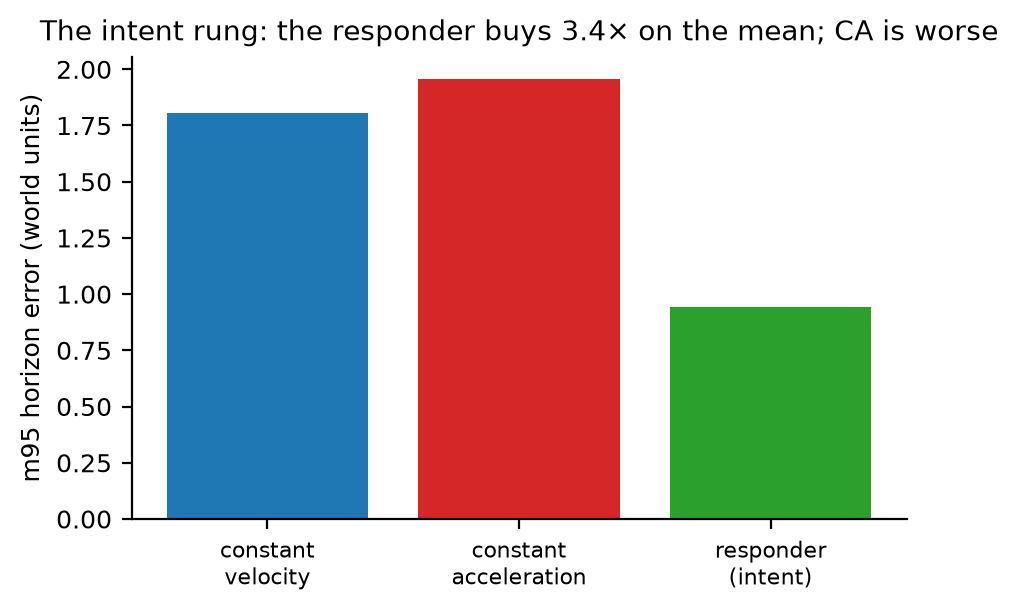
The ladder's third model — and a warning from the second. Three others-models are measured paired on the same trajectories (M-EP, 1777 samples): constant velocity (rung 1), constant acceleration (rung 2), and the responder — a joint lockstep simulation of the others' greedy policies at the predicted state (rung 3). The result split cleanly (Table 11, Figure 13):
| model | mean | m95 | m99 |
|---|---|---|---|
| constant velocity | 0.923 | 1.807 | 2.587 |
| constant acceleration | 1.203 | 1.957 | 4.714 |
| responder (intent) | 0.273 | 0.945 | 1.867 |
Table 11. M-EP (epsilon.json): the intent signal is real — the responder model
buys 3.4× on the mean — but CA is worse than CV: with heavy damping and bang-bang
actions, finite-difference acceleration is noise, so the ladder is regime-dependent,
not monotone in model order.
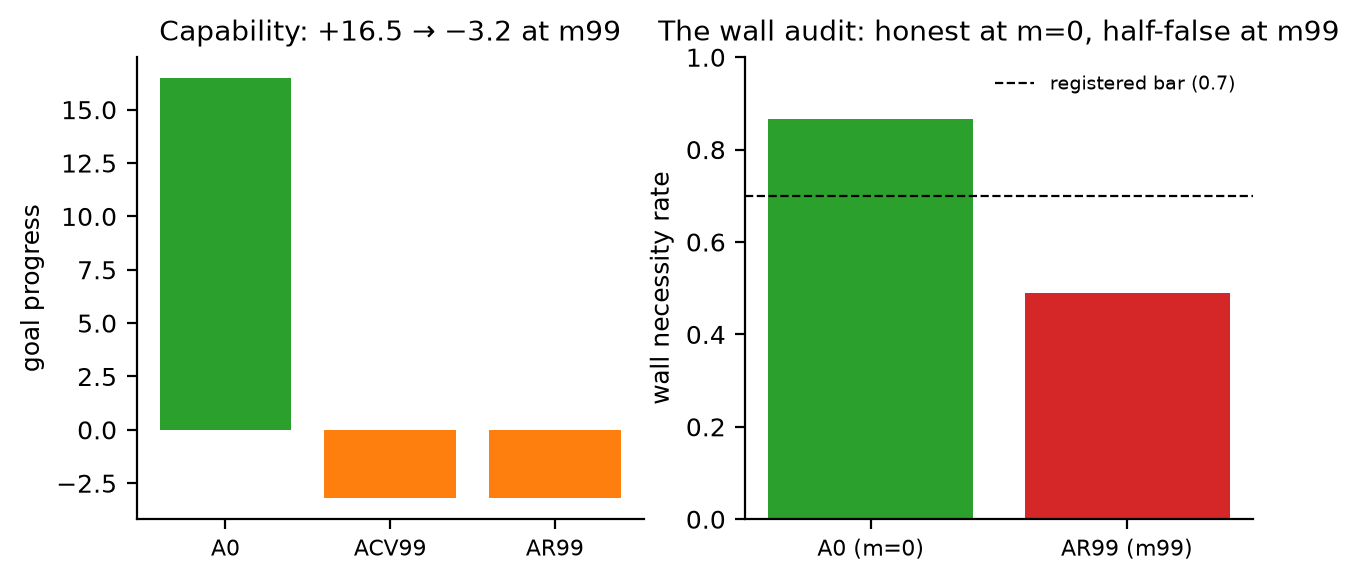
Containment holds perfectly; capability does not. The T7 arms (responder model at m99; CV at m99 as the transplanted rung) reproduce §4.8's pattern at the intent regime's scale: certified contacts = 0 in every arm, across 4500 steps — wherever the guard speaks, it is right (T7-2). But T7-1 fails at ratio 0.523 (the residual after perfect intent knowledge is contact physics — elastic impulses the policy-level model cannot see), and T7-3 collapses into the same cowardice as §4.8: at m99 the guard walls on every step (1500/1500), progress turns negative (−3.20 vs A0's +16.47), and the two margin arms are identical regardless of model — at that margin the model simply doesn't matter.
The attack: auditing the wall — and finding a one-sidedness. MPE's determinism makes the wall's pessimism auditable: at 60 sampled wall events, the full state is written into a fresh engine and all five held-action alternatives are simulated in the true dynamics (others keep their greedy policies). The wall is necessary — no alternative survives — in 87% of the m=0 arm's walls, but only 49% of the m99 arm's (T8-1, FAIL against the registered 0.7). The margin does not merely disable the guard; it poisons the abstain path's existence claim. This is a logical asymmetry worth stating on its own: a clearance margin is a one-sided certificate — it can certify negatives ("this action is safe up to ε") but never positives ("no action is safe"), because the positive claim is made of the very distances the margin has inflated. The companion attack (T8-2) failed to land: the margin premise transports on-policy (m95 ratio 0.83 — drift is more predictable, not less), so the theorem keeps its form with the transport measured rather than assumed.
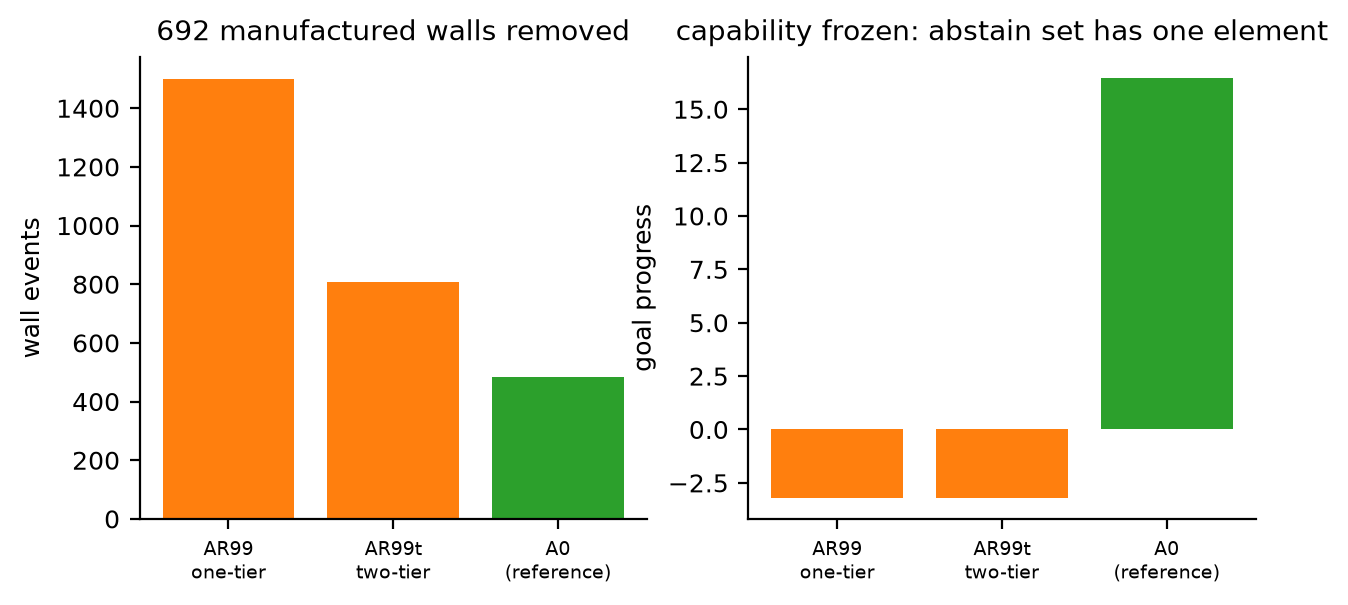
The amendment, and what it restores. The two-tier guard (H-ATK2) implements the asymmetry directly: proposals are certified at the margin (soundness), but the abstain alternative is certified at true distance (wall_margin = 0), and the wall fires only on necessary failure. The result is a clean separation of what the fix can and cannot do: manufactured walls drop by 46% (1500 → 808) with certified contacts still 0 — the claim is repaired and proposal-path soundness is untouched — but progress is identical to the single-tier arm (−3.20). The reason is structural, and it closes the loop with §4.5: with an abstain set of one action (STAY), correcting which states are truly unwinnable cannot change what the system does there — both tiers execute STAY either way. Honesty about unsafety is not capability; capability requires the abstain set to contain maneuvers — the same lesson highway's abstain wall taught (§4.5), now derived from the opposite direction: fix the truth-telling first, then grow the set. (Table 12, Figure 15.)
| arm | wall margin | wall events | certified contacts | progress |
|---|---|---|---|---|
| AR99 (one-tier) | 1.867 | 1500 | 0 | −3.20 |
| AR99t (two-tier) | proposals 1.867 / abstain 0 | 808 | 0 | −3.20 |
| A0 (reference) | 0 | 483 | 0 | +16.47 |
Table 12. H-ATK2 (tier.json): the two-tier guard removes 692 manufactured walls
without touching proposal soundness; capability stays frozen because the abstain set
has one element — honesty is not capability.
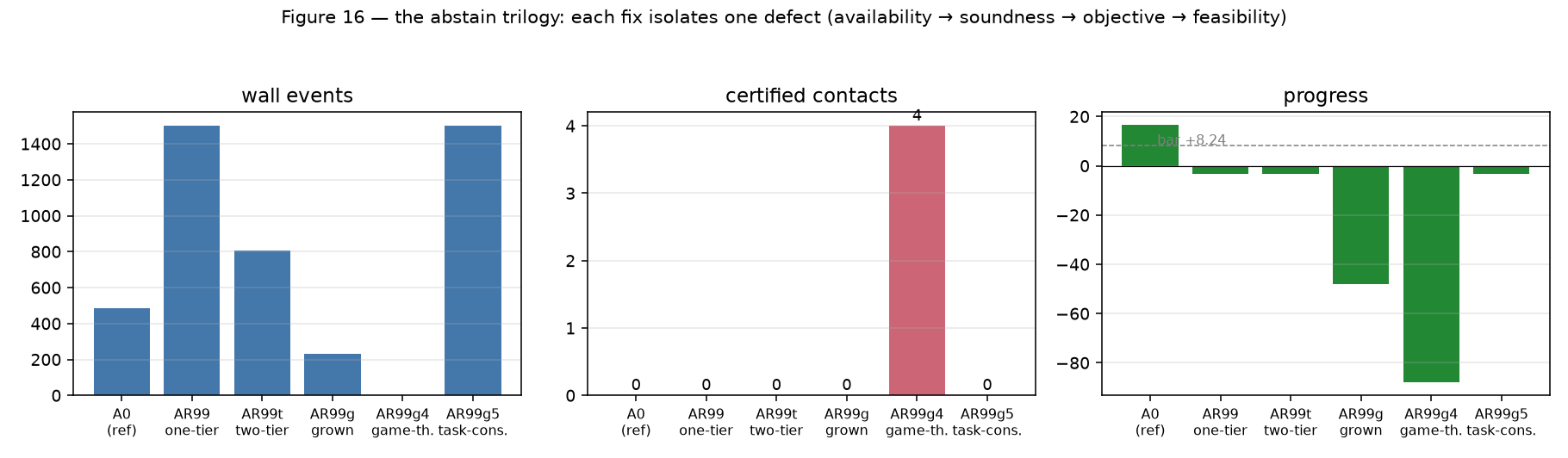
The abstain trilogy: each fix isolates one defect. §4.9's two-tier guard repaired the wall's existence claim but left capability frozen, because the abstain set held a single action. Three registered attacks grow and then choose it — and each failure names exactly one thing the naive design got wrong (Table 13, Figure 16).
Availability is not enough (H-ATK3). Growing the set to {STAY, evade} — where
evade steps away from the nearest opponent — removes 71% of the manufactured walls
(808 → 232, AT3-1 PASS) with certified contacts still 0 (AT3-2 PASS), but
progress collapses to −47.92 (AT3-3 FAIL, spectacularly). Greedy evasion is
exploitable: fleeing the nearest opponent herds the ego into the reach of the next,
so the abstain maneuver must be chosen against a reacting opponent, not a static one.
Game-theoretic choice: the walls vanish, soundness breaks (H-ATK4). Choosing the abstain maneuver by predicted worst-case clearance under the chase simulation (max–min) drives walls to 0 — vacuously, since every state now finds a predicted-safe maneuver — but certified contacts rise to 4 (AT4-2 FAIL) and progress to −88.02 (AT4-3 FAIL). The max–min maneuver maximizes flight, not task: the ego retreats, and the maneuver that maximizes predicted clearance is executed unsound at the error's tail. This isolates the objective defect — an abstain maneuver must be chosen for the task.
The doctrine, and the margin's magnitude (H-ATK5). The three-way doctrine is now implemented literally: existence at true distance (the wall is honest), execution certified at the margin (soundness), and — among margin-feasible candidates — the one minimizing predicted distance-to-goal (task-first). The result: walls 1500, certified contacts 0, progress −3.20 (AT5-1/2/3 FAIL). The failure is not a mechanism but a magnitude: at m99 = 1.867 no abstain maneuver certifies at all (0 of 1500 steps), so the guard falls to the wall every step and executes STAY — identical to the single-tier arm. The catch-22 is now fully visible: execution at true distance is unsound (AT4's 4 breaches), execution at m99 is infeasible (AT5's 1500 walls), and the wall's existence claim requires true distance. A scalar margin cannot be both ≥ ε (soundness) and ≪ the interaction distance (feasibility), because ε's tail (1.9 world units) dwarfs the contact radius (0.3). It is feasible only if ε itself shrinks — the structure-aware (tube) margin §4.8 derived from the dynamics side, now forced from the abstain side. Two substrates, two error sources, one requirement.
| attack | abstain design | walls | certified contacts | progress |
|---|---|---|---|---|
| H-ATK2 | {STAY}, two-tier |
808 | 0 | −3.20 |
| H-ATK3 | {STAY, evade}, greedy |
232 | 0 | −47.92 |
| H-ATK4 | {STAY, evade}, max–min clearance |
0 | 4 | −88.02 |
| H-ATK5 | {STAY, evade}, margin-certified, task-first |
1500 | 0 | −3.20 |
| A0 (reference) | — | 483 | 0 | +16.47 |
Table 13. The abstain trilogy (grown.json, atk4.json, atk5.json): availability
(H-ATK3) fixes walls but is exploitable; the game-theoretic choice (H-ATK4) removes walls
but breaks soundness and the objective; the full doctrine (H-ATK5) is correct but the
scalar margin at m99 makes execution infeasible — the failure migrates from mechanism to
magnitude.
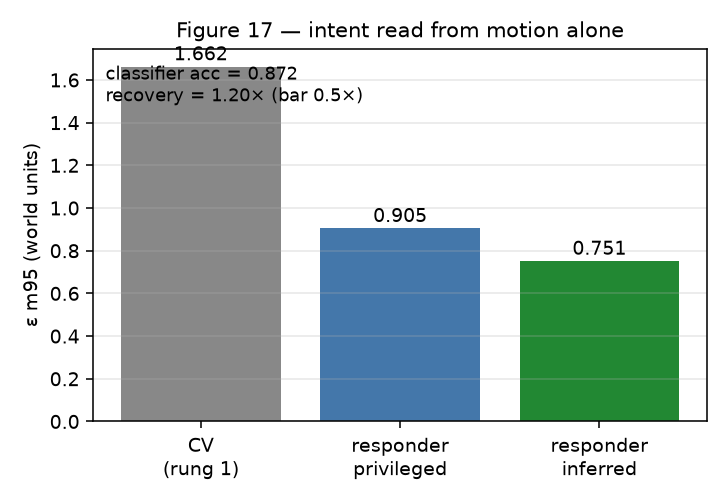
The circularity closes: intent without privilege. The responder model of §4.9 used the others' known policy — a privileged tag the bias–predicate theorem cannot assume. T8-3 removes it. A seeded logistic classifier reads each other's intent (ego-directed chase vs landmark-directed) from a W = 10 relative-motion history alone — features ego-directedness, goal-directedness, closing speed, bearing rate, speed, and distance — with held-out accuracy 0.872 (T8-3a PASS, bar 0.85; 2583 train / 861 test). Substituted into the responder model, the inferred ε m95 is 0.751 against the privileged 0.905 and CV 1.662 — a recovery of 1.20× of the privileged gain (T8-3b PASS, bar 0.5). Privilege is not required: intent is inferable from motion alone (Table 14, Figure 17). Disclosure: recovery > 1 means the inferred model beat the privileged one — the oracle tag is not the optimum of the response family, so the correct reference bound is the best response predictor in the family, not "privileged intent."
| responder model | intent source | ε m95 |
|---|---|---|
| constant velocity | none (rung 1) | 1.662 |
| responder (privileged) | oracle policy tag | 0.905 |
| responder (inferred) | classifier from motion | 0.751 |
Table 14. T8-3 (t83.json): the intent signal survives the removal of privilege —
a motion-only classifier recovers (and slightly exceeds) the oracle-tagged model's error
reduction.
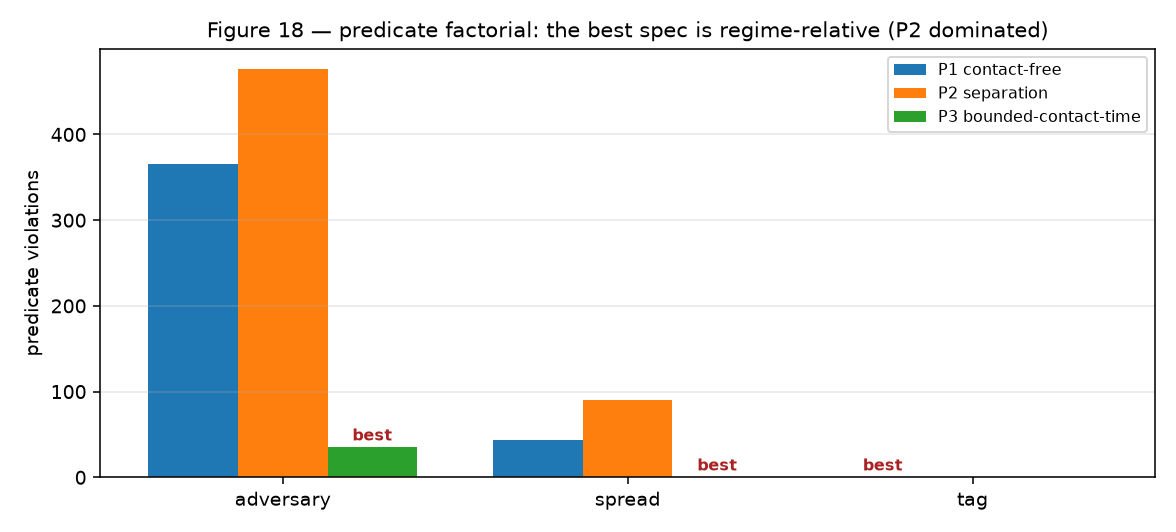
Is the safety spec regime-relative? Yes — and stricter is not safer. T8-4 crosses
three predicates — P1 contact-free (violation iff distance < 0), P2 separation
(violation iff raw distance < 0.2), P3 bounded-contact-time (violation iff contact
persists > 5 consecutive steps) — with the three scenarios, arm A0* (execute the
deployment action if it is certified safe under the predicate within the horizon, else
STAY). The best predicate by (fewest violations, then most progress) differs across
scenarios — P3, P3, P1 (Table 15, Figure 18) — so safety is regime-relative
(T8-4 PASS, ≥ 2 distinct optima). Two disclosures. First, in tag no predicate is
violated (the ego never contacts), so that scenario is vacuous for the spec question —
its "P1 optimum" is a progress tie-break among three zero-violation predicates. Second,
and counterintuitive: P2 (separation) is dominated everywhere, and in adversary it
has more raw violations than P1 (476 vs 366). Tightening the contact predicate
does not buy safety, because the larger forbidden zone forces more abstains, and the
abstain maneuvers are themselves contact-producing. A stricter safety predicate can
increase raw violations — the monotonicity intuition (stricter ⇒ safer) is false in
this regime.
| scenario | P1 contact-free | P2 separation | P3 bounded-contact-time |
|---|---|---|---|
| adversary | 366 / 1.317 | 476 / 1.181 | 35 / 1.782 |
| spread | 43 / 1.121 | 90 / 1.769 | 0 / 1.510 |
| tag | 0 / 14.037 | 0 / 14.037 | 0 / 13.508 |
Table 15. T8-4 (t84.json): predicate violations / progress per cell (A0*). The
best spec differs across scenarios (bold) — regime-relative — and P2 (a stricter
contact predicate) is dominated everywhere, with more violations than P1 in
adversary: enforcement of a wider forbidden zone generates more contact.
Taken together with §4.8, Thm 5's empirical form now spans three error sources: dynamics (highway: exhausted at rung two), intent (MPE: bought at 3.4×, residual = contact physics), and — named for the next substrate — perception. The margin protocol itself survived every attack unchanged; what each attack refined is where the margin may be used (proposals) and where it may not (existence claims). The abstain path went further and named a quantity: it needs the model three times (existence, execution, synthesis) and the margin once per job, and a scalar margin at the error's m99 quantile satisfies soundness and feasibility only if the error itself is structure-aware — the requirement §4.8 reached from the dynamics side and §4.9 reaches from the abstain side. That convergence, not any single arm, is the section's result: the margin's form is a theorem-level obligation, not a tuning choice.
4.10 The monitor: from predicting failure to checking contracts
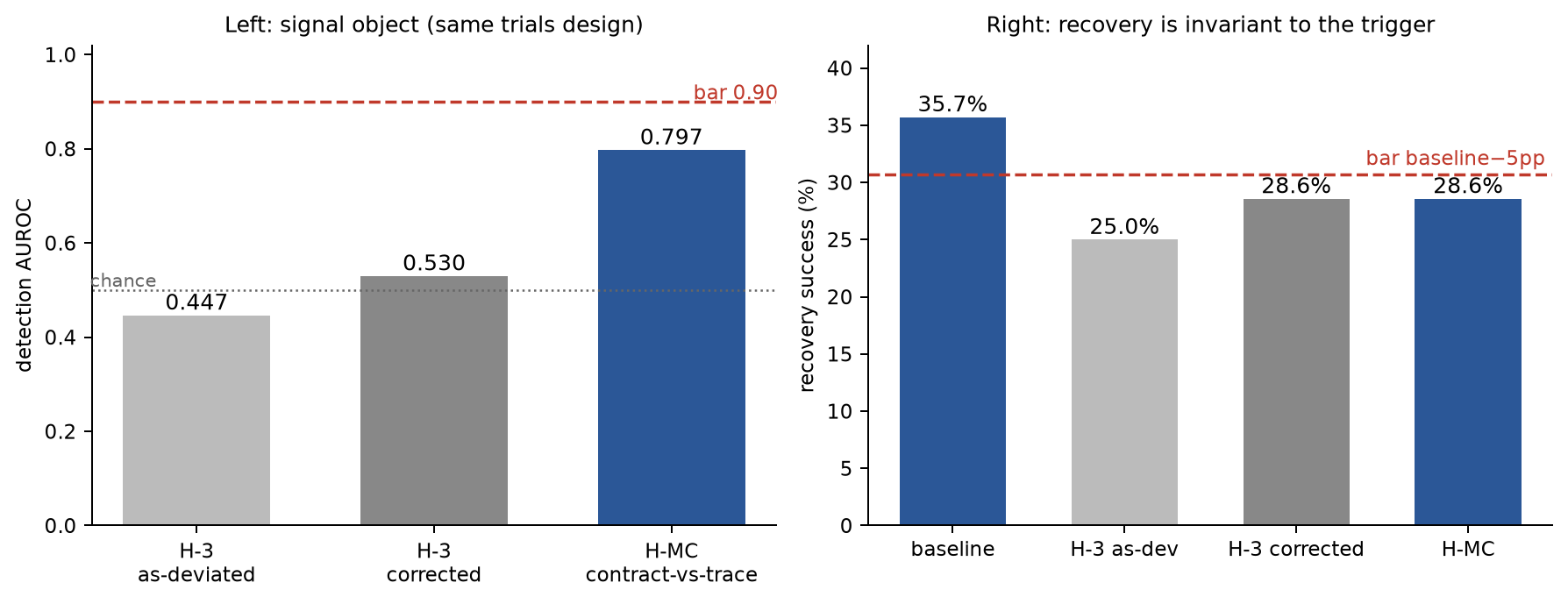
The last component of Ω — and the one this paper's first registration left failing — is the runtime monitor. H-3 scored a pre-execution scene signal (guard refutation, scene TTC, target-lane occupancy) against the label that the committed maneuver's postcondition fails within a four-step window. It failed twice: AUROC 0.447 with a score/label deviation the correction ledger preserves (the monitor scored the proposed action while the label described the executed one), and 0.530 protocol-correct — chance (886 windows, 392 positives). The negative is structural rather than a tuning matter: the surprise that breaks a maneuver has not happened yet at decision time, so no function of the scene at decision time can see it.
H-MC registers the object the framework's mapping always described: a maneuver is a contract — an intent postcondition (the same claim form §4.5 found the abstain path missing) plus the guard's safety claim for the executed action — and monitoring is checking that contract against the partial trace (addendum H-MC, registered before the run). Everything else is inherited from H-3 unchanged — arms, perturbation injection, window and censoring, replan budget, AUROC estimator — so the comparison isolates the monitored quantity alone. The score at each in-window step is computed causally from the partial trace: lateral progress toward a committed lane change, delivered speed change against the committed ±1 m/s, an IDLE commitment whose lane moves anyway. The pre-outcome rule is fixed in the registration: a window's score is the maximum over scenes strictly before the outcome — neither the crash step nor the postcondition-maturity scene contributes. Detection must be early, or it does not count.
The object change lifts detection from chance to 0.797 (890 windows, 393 positives; registered bar 0.90; Table 16, Figure 20) — a +0.267 AUROC gain from the same trials design, and the residual is identifiable rather than diffuse. Windows opened under a satisfied contract and then struck by the injected surprise — the mid-window hard brake or cut-in — carry no contract-violation evidence before maturing, because the surprise is not a breach of any clause the contract contained. Contract monitoring checks what was contracted; it cannot foresee the exogenous. The recovery arm (MC-2) misses its bar at exactly H-3's rates — 28.6% against a 35.7% baseline, −7.1pp against the −5pp bar — and the redundancy is diagnostic: 50 replans against H-3's 16 produce identical success rates, so recovery's binding constraint is the replan's efficacy within budget 3, not the trigger that calls it. The component is now bounded from both sides: chance for scene-level prediction, 0.797 for trace-level contract checking, 0.90 still open — and the bound's shape, contract-relevant failure detectable and exogenous surprise not, is the monitor's characterized frontier rather than an unmeasured guess.
| monitor | signal (object) | AUROC | windows / positives | recovery vs baseline | replans |
|---|---|---|---|---|---|
| H-3 as-deviated | pre-execution scene | 0.447 | — | −10.7pp | 65 |
| H-3 protocol-corrected | pre-execution scene | 0.530 | 886 / 392 | −7.1pp | 16 |
| H-MC | contract vs partial trace | 0.797 | 890 / 393 | −7.1pp | 50 |
| registered bar | — | ≥ 0.90 | — | ≥ −5pp | ≤ 3/ep |
Table 16. The monitor's object, ablated (monitor_asdev.json, monitor.json,
contract_monitor.json). Moving the signal from the scene at decision time to the
guard's contracts checked against the partial trace is the entire difference between
chance and near-detection; recovery is invariant across all three rows, isolating its
constraint outside the monitor.
5. The law
Ten results, one law: the safety boundary is the authority's model, not the proposer. The one-step guard's failure was a defect in the model's horizon (§4.1); the lookahead guard repaired it and exposed the model's dynamics as the residual (§4.2); the corpus's key had to match the situation, not the scenario (§4.3); and the distilled claims had to be certified against the model's reachable set, not a sample (§4.4); the abstain path needed the same horizon-soundness as acceptance, and its failure exposed the model's abstain set (§4.5); the measured regime governs a claim's benefit (§4.6); the ablation splits the layers — safety in the dynamics model, competence in the predicates, speed in the proposer (§4.7); the margin ladder prices the model's fidelity in capability, rung by rung (§4.8); and the intent rung prices what kinematics cannot — where the attack surfaced the one-sidedness of margin certificates (§4.9), the abstain trilogy isolated the margin's form as a theorem-level obligation, privilege-free intent removed the responder model's oracle tag, and the predicate factorial showed the spec itself is regime-relative (§4.9); and the monitor changed object — from a pre-execution prediction of failure (0.530, chance) to a check of the guard's own contracts against the partial trace (0.797), which bounds it rather than perfects it (§4.10). Each falsifier named a specific piece of the model to strengthen — and the strengthened piece is always the authority.
This is the same law the theory paper states for learned heuristics (choose the bias for the predicate), now observed on the safety side: the model that the guarantee rests on is the thing that must be right, and improving it is what the framework buys.
Table 17 is the law as a journey: one row per turn of the loop §3 stated, the registered falsifier each turn, the component of Ω it named, the price measured after repair, and the section that reports it. The nine rows are exhaustive over §4 — and the tenth, the registered perception substrate, is reported as obligation, not evidence.
| turn | falsifier (registered before run) | component of Ω strengthened | measured price | § |
|---|---|---|---|---|
| attack | GS-1, held-out proposers | guard's horizon (k = 1 → k = 3) | 27 → 2 ego-initiated (93%) | 4.1–4.2 |
| attack | CT-1, certificate semantics | claims certified against the reachable set, not a sample | 748/5369 → 0 violations | 4.3–4.4 |
| attack | abstain-path audit (H-CT/H-S) | fallback certification | 93% of crashes on unchecked fallbacks → certified-or-disclosed | 4.5 |
| measure | H-RP, dose–response; H-6-D | regime prior $R$, recorded not predicted | ρ = 0.79 | 4.6–4.7 |
| attack | H-T5, H-T6, model ladder | margin = ε̂ at the kinematics rung | CV ≡ CA (ratio 1.0008): budget exhausted | 4.8 |
| attack | T7; H-ATK2–5, abstain trilogy | responder model; three-way abstain doctrine | intent buys 3.4×; scalar margin named a theorem obligation | 4.9 |
| measure | T8-3, privilege-free intent | intent without the oracle tag | acc 0.872; recovery 1.20× | 4.9 |
| attack | T8-4, predicate factorial | the spec itself | regime-relative; stricter ≠ safer | 4.9 |
| attack | H-3 → H-MC, contract vs trace | the monitor's object: scene → partial trace | AUROC 0.530 → 0.797 (bar 0.90 open); recovery invariant | 4.10 |
| next | perception channel (registered) | model M's third error source | — | 6 |
Table 17. The journey: ten turns of the loop (§3), one row per §4 falsifier. Every row's bar was registered before its run; every price is read from the artifacts listed in §8; the last row is the registered next substrate — reported as obligation, not evidence.
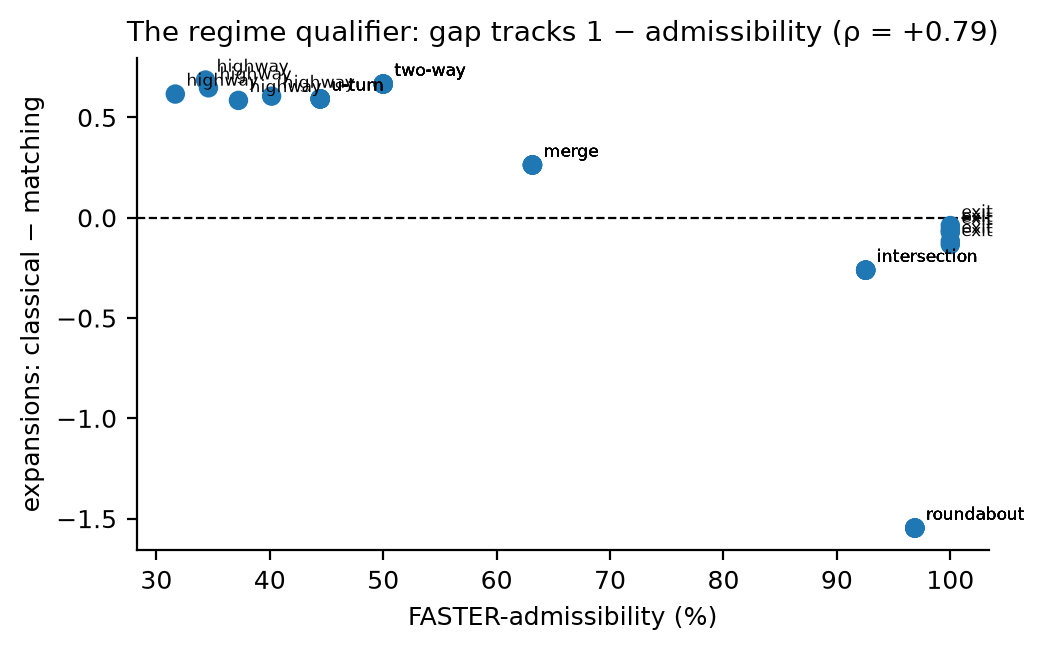
The law needs its regime qualifier. The bias experiment that missed its crossing bar (matching-bias 1.02× classical, reported FAIL) is explained by measurement, not rescued by caveat: per scenario, the classical−matching expansion gap tracks $1 - \text{FASTER-admissibility}$ at ρ = +0.79. Where the regime makes a predicate-blind bias optimal (roundabout, 97% admissible: matching costs 1.5 expansions), matching cannot win; where it does not (highway, 36%: matching wins +0.63), it wins decisively. The aggregate that failed (1.02×) averaged opposing regimes — the regime lives in the scenario's traffic structure, not in density. This is Theorem 4's triple $(\mathcal{H}, P, R)$ observed on the safety substrate: without $R$ the law is falsified by its own aggregate; with $R$, every cell falls on the line.
The law's last corollary — the fidelity budget. §4.8 adds the economic form: capability ∝ model fidelity, priced by a margin equal to the measured error — and in interactive traffic that fidelity is bounded by kinematics, exhausted at rung two (CV ≡ CA, ratio 1.0008). What the guard cannot buy at any kinematic order is the reaction of the others; the residual budget of containment is intent. The law and its corollary now name the same destination from both sides: the model is the deliverable, and the next model is not a better extrapolator — it is a responder. §4.9 supplies the two properties that make the responder a framework object rather than a substrate artifact: its intent is inferable without privilege (T8-3), and the spec it enforces is regime-relative (T8-4) — while the margin it consumes must be structure-aware to be both sound and feasible (§4.9).
6. Limitations and open problems
The approximate-authority residual — characterized. The certified classes (2 proposal- plus 5 abstain-certified) were priced in §4.8: a clearance margin equal to the model's measured horizon error eliminates them, but on this substrate the scalar that covers the constant-velocity model (m95 = 12.9 m) disables the guard, and the constant-acceleration ladder rung reduces the error by a ratio of 1.0008 — kinematics is exhausted. What remains is no longer an open question but a characterized frontier: containment under an approximate authority holds at margin = measured error, capability tracks fidelity, and the fidelity budget in interactive traffic is spent on intent, not kinematics. §4.9 climbed the intent rung and sharpened the residual further: on MPE the responder model buys 3.4× on the mean error, its intent is recoverable without privilege (T8-3), and its containment residual is contact physics — but the abstain path then exposed a quantitative requirement the scalar margin cannot meet (AT4/AT5): the margin must be ≥ ε to be sound and ≪ the interaction distance to be feasible, which a scalar at ε's m99 quantile (1.9 world units against a 0.3 contact radius) cannot be. The remaining work is now precisely named: a structure-aware (tube) margin whose width is a function of the error's structure, not its quantile — reached independently from the dynamics side (§4.8) and the abstain side (§4.9). The theorem's remaining task is the intent-tube model (a responder, not an extrapolator) and its tube-margin proof — and the substrate where others are agents, i.e. the multiagent probe and, for the perceptual error source, the next one.
The abstain set — closed as a mechanism question. Horizon-certifying the fallback
changed accounting, not outcomes: within {SLOWER, IDLE} the wall fires about once per
episode (11 wall-class crashes / 28). §4.9 grew the set and chose it game-theoretically,
and the trilogy closed the mechanism question: availability (H-ATK3), soundness
(H-ATK4), and objective (H-ATK5) each isolate one defect, and the full three-way
doctrine is correct — its residual failure is the scalar margin's magnitude, not the
abstain set's design. The open item therefore migrates from "grow the set" to the
structure-aware margin named above: with a tube margin the margin-feasible abstain
set becomes non-empty, and the H-ATK5 wall disappears without a further mechanism.
The monitor's remaining limits. Both registrations are reported in §4.10: as a predictor the monitor is at chance (0.530); as a checker of the guard's contracts against the partial trace it reaches 0.797 — bounded, not solved. What stays open is precisely what the bound isolates. The exogenous surprise falls under no clause the ego's contracts contain, so detecting it would require contracts over the environment's commitments (right-of-way, braking distance, lane discipline) rather than the ego's — a different registration again. And recovery remains gated by the replan's efficacy, not the trigger: within budget 3, the certified search does not rescue perturbed episodes regardless of when it is called.
The learned proposer's features. Capacity was not the binding constraint: 4× data moved the linear model +2.6pp and a 64-unit MLP ceilinged at 0.745 agreement (bar 0.80). The fingerprint's aliasing is — richer features (explicit TTC/gap/leader structure) are the next move (H-PQ3), not bigger models.
Closed: the regime prior. §4.4's named next move is measured and passed (ρ = 0.79, target-measured beats mismatched, containment held). Certification says the claim is true; the measured regime says where it matters — and the measurement is an environment fact the authority records.
The attribution heuristic. Ego- versus other-initiated is decided by a documented geometric heuristic (was the contact partner ahead of the moving ego's heading). It is a reasonable proxy, not ground truth, and a finer attribution would sharpen §4.1.
Scope. Simulation only; sim2real is out of scope. The continuous scenarios have no discrete guard and are recorded as such rather than silently included. The monitor's contract semantics and the grown abstain set are registered but unrun.
7. Conclusion
We attacked a structural guarantee on a real substrate rather than assume it, and the attack succeeded twice: a one-step guard is not sound containment for dynamics with memory (27 ego-initiated against a bar of 0), and — once every executed action was classified — the repaired guard's abstain path was not sound either (93% of the remaining crashes lived on unchecked fallbacks). Each repair is the same shape: extend the horizon-soundness requirement to what the guard actually executes, accepted or abstained. What survives both repairs is the model's own error — and §4.8 priced it: a margin equal to the model's measured error eliminates the certified classes but, on this substrate, buys containment with the brake pedal; the ladder rung that was supposed to buy it back (constant acceleration) reduces the error by a ratio of 1.0008. The fidelity budget in interactive traffic is spent on kinematics by rung two. What remains is intent — which is why the programme's next substrate is the one where others are agents, and why the measuring instrument built here (measure the model, certify at its error, report the walls) travels with it.
The efficiency side obeys the same law: the key must be structural, "certified" must mean certified against the reachable set, and a claim's benefit is governed by the substrate's measured visitation (ρ = 0.79) — an environment fact, recorded, never predicted. The ablation says what each layer is for: safety lives in the dynamics model (invariant to predicate corruption), competence in the predicates, speed in the proposer — where a cloned MLP eventually earned its seat (20.16 ≥ 19.81 m/s) while the certified safety classes stayed literally identical across every proposer quality. What remains is not more data but a better model — of the dynamics, of the abstain set, and of the trace a maneuver's contract leaves behind.
References
[1] E. P. Denadai. Containment Rather Than Calibration: A Sound Architecture for Learning Under Partial Observability. Optimality.ai, 2026.
[2] E. P. Denadai. Exact-Authority Belief-Space Planning: Where Composition Emerges and Where It Fails. Optimality.ai, 2026.
[3] E. P. Denadai. Learnable Boundaries, Unlearnable Competence: A Characterization of Learned Components in a Symbolic Search Stack. Optimality.ai, 2026.
[4] E. P. Denadai. The Cost of Soundness: f-Contour Bounds and the Inductive-Bias Limits of Learned Heuristics. Optimality.ai, 2026.
8. Provenance
Every number and figure is read from
env_substrates/highway/results/{scenarios,safety,transfer,fragments,fragments_library,
handshake,grounding,bias,monitor,contract_monitor,regime,surgical,proposer,
bias_regime,abstain,capacity,thm5,thm6}.json
, and for §4.9 the multiagent substrate's
{h0_adversary,epsilon,ladder,attack,tier,grown,atk4,atk5,t83,t84}.json (rendered offline by its own
render_mpe.py — a pure-JSON viewer with the EGO marked)
by make_figures.py; the substrate code is in
env_substrates/highway/ (authority.py, highway_env_adapter.py, corpus.py,
fragments.py, and the run_*.py drivers). Bars were registered in
env_substrates/highway/docs/PLAN.md before each run — including the closure addenda
(H-ORE, H-RP, H-SC, H-PQ, H-6-D, H-S3, H-PQ2), the Thm-5 arc (H-T5, H-T6), and the
contract monitor (H-MC, registered before run_contract_monitor.py); §4.9's
bars (M-EP, T7, T8-1/2, H-ATK2–H-ATK5, T8-3, T8-4) were registered in
env_substrates/multiagent/PLAN.md before their runs, with the T8-3 recovery-ratio
miscalibration and the T8-4 degeneracy disclosed in the text; failed
bars are reported where they occurred (Tables 2, 3, 4, 6, 7, 8, 9, 10; H-4's VOID,
H-6's and PQ-1's and PQ2-0's and T5-2's and T6-1's and T6-3's FAILs).
The correction ledger (the tau-wrapper defect and its preserved *_astau0.json
as-run artifacts; the monitor score/label deviation; PQ-2's registration ambiguity;
the H-T5 id-matching fix and the disclosed cross-process ε drift) lives
in the substrate PLAN and §4.2. The paper's own section/figure set was registered in
PLAN.md before these sections were written. Figures: fig1 (where
containment breaks), fig2 (guard activity), fig3 (corpus growth), fig4 (transfer),
fig5 (retention), fig6 (one-step vs lookahead), fig7 (abstain taxonomy),
fig8 (regime dose–response), fig9 (regime qualifier), fig10 (proposer seat),
fig11 (margin economics), fig12 (model ladder), fig13 (intent ladder), fig14
(capability and wall), fig15 (two-tier guard), fig16 (abstain trilogy), fig17
(privilege-free intent), fig18 (predicate factorial); fig16–fig18 are generated by
imgs/make_figs_49b.py from the multiagent artifacts, and
fig20 (the monitor's signal object and recovery, from
monitor{,_asdev,contract_monitor}.json), and fig19 (the Ω-TD architecture — a
structural diagram carrying no data, registered
in PLAN.md addendum ARCH before generation, source
fig19.d2, rendered by the D2 compiler and invoked by
make_figures.py). The paper's architecture frame (§3: the two
invariants, the loop), §4.10 and its Table 16, and the journey table (Table 17, §5 —
ten registered turns, one
per §4 falsifier, placed in §5 to keep the table sequence 1–16 monotone; recorded as a
placement correction in PLAN.md) are registered in the same addendum. Contract tests: env_substrates/highway/test_highway.py (9 checks) and
env_substrates/multiagent/test_multiagent.py (3 checks) — all passing. The
experiment trace lives in the PLAN and the artifacts, not here.