Abstract
A verification-centric system lets a learned proposer direct a pinned, exact authority without ever being trusted with the guarantee: the authority owns the guard, the proposer only restricts. Two questions follow. What does that certification cost in search effort? And, within that cost, can a learned heuristic ever beat a classical one?
We answer both with a small theory and a controlled empirical programme. The cost of certification is geometric — a certifying search expands exactly the region where the heuristic's estimate falls below the true cost, so its price is the volume of the f-contour — and a learned heuristic can beat a classical one only by reducing that heuristic's error (Theorem 3). We then test the question empirically, one axis at a time. The first result is a negative: a certified "accelerator" that appeared to beat the classical baseline at $0.72\times$ nodes was, at matched weight, worth $1.00$–$1.06\times$ — the speedup was the greedy weight, not the learned heuristic. The second is a positive: the apparent wall is not that global functions are unlearnable, but that they are not learnable by architectures whose inductive bias is local — a differentiable relaxation whose recurrence is the layer crosses the tight classical heuristic at $0.93\times$, stays at $\approx 0.90\times$ across sizes 9→21, and, on a second global predicate, crosses at $0.96\times$ only when its bias is rebuilt to match that predicate. We state these as theorems with constructive proofs, name the design rule they hand to practice — choose the bias for the predicate — and pose the open problem they leave: a characterization of for which (architecture, predicate, regime) triples a class can match a predicate. We then measure the regime axis of that open problem on a second substrate — certified search over continuous traffic — where the law without the regime fails its own crossing bar ($1.02\times$) and the regime qualifier carries it cell by cell at $\rho = +0.79$: part (iii) of the theorem moves from assertion to empirical necessity. We name the class of systems: sound-by-verification.
1. Introduction
This is the fourth paper in a series on the $\Omega$-TD neurosymbolic architecture. The first three established the architecture [1], its belief-space generalization [2], and an empirical characterization of the learned components [3]. This paper supplies the theory those results require: what certification costs — the f-contour bound — and what a learned heuristic can buy inside it, the inductive-bias law that governs the crossing, and its extension to transfer across scales and predicates.
Verification-centric architectures are built on a division of labour: a pinned authority $\Omega$ — deterministic, parameter-free, returning a typed verdict — a proposer $\pi$ that may be a learned model, a search, or an adversary, and a guard owned by the authority. Execution selects from the guard's admissible set plus an abstention; the proposer's only power is to choose within it. The safety of such a system is structural and, as we recall in §2, does not depend on the proposer at all.
What is not structural is its efficiency. A certifying search must still search: it expands the states whose estimated cost could still undercut the true optimum, and the learned heuristic is used only to order that search. Two questions therefore define the field. First, what does certification cost — how many nodes must be expanded before the authority is satisfied? Second, can learning pay for itself inside that cost — is there a learned heuristic that beats the best classical one?
The second question is easy to ask badly. Reported "learned accelerators" in this space have repeatedly measured the weight of a weighted search rather than the heuristic (e.g. §4.1), and the honest measurement requires the matched-weight control — hold the certified suboptimality budget fixed and compare only the heuristic. Our contribution is to take that control seriously, and then to take the resulting negative seriously: the question is not whether a learned heuristic helps, but what property of a model makes one possible.
We give three results, in the order they were discovered:
- The apparent speedup was the weight. At matched weight the learned heuristic's marginal value is $1.00$–$1.06\times$ (§4.1). The negative is not a dead end; it is a refocusing of the question onto error reduction.
- The wall is inductive bias, not learnability. Holding capacity fixed, three model families told one story: the local and generic arms cannot reduce the error of a tight classical heuristic, while a differentiable relaxation — whose recurrence is the layer — crosses at $0.93\times$ (§4.2). The crossing survives a scale sweep (§4.3).
- The bias must match the predicate. On a second global predicate, the same relaxation fails ($1.58\times$) until its bias is rebuilt for that predicate, at which point it crosses ($0.96\times$) (§4.4).
From these we state the general law as a theorem (Thm 4) and hand practice the design rule choose the bias for the predicate (§5), leaving one open problem (§6).
2. Preliminaries: containment and the price of certification
Containment. With exact evidence channels, a parameter-free guard, and always-available abstention, the proposer cannot leave the safe set — for an arbitrary proposer (Theorem 1; composition in Theorem 2). Safety is thus structural, and the interesting question moves to cost.
The f-contour. Consider an exact search (A*) to a goal of optimal cost $C^\*$ under a heuristic $h$. A* expands exactly the states with $g(n)+h(n) < C^\*$, so the cost of the search is the volume of the f-contour $\mathcal F(h)$ — a purely geometric quantity determined by $h$. With relative error $\varepsilon$, expansions are bounded by the volume of $\{f \le (1+\varepsilon)C^\*\}$ (Dechter–Pearl; Korf).
Theorem 3 (No speed without error reduction). Let $h_c$ be an admissible classical heuristic and $h_\theta$ a learned heuristic used only to order a certifying search. If $h_\theta$ has no smaller error than $h_c$, the certified search with $h_\theta$ expands no fewer nodes than with $h_c$.
The proof is one line of monotonicity: $\mathcal F$ shrinks only as the pointwise under-estimate of $h$ grows, and a larger error means a smaller estimate. Two corollaries follow. The weight of a weighted search is classical — any admissible $h$ may be used — so an apparent speedup that compares weighted-learned against unweighted-classical is measuring the weight. And because $h^\*$ is a global function (s-t-connectivity-like, $L$/$NL$-complete), reducing error below a tight classical heuristic is a learnability question about the model class, not about data or capacity.
3. Method: change one axis, watch which way the ceiling moves
The corollaries are testable, and so is the boundary they describe. Our method is to change one axis at a time — capacity, certificate, inductive bias — and observe which one moves the ceiling. A limit that survives every axis-swap is fundamental; one that falls is a design choice in disguise. Each experiment registers its bars and falsifiers before the run, and each carries a control matched on the axis it is supposed to isolate: the matched-weight control (§4.1), fixed-capacity arms (§4.2), and the predicate ablation (§4.4). The substrate is a family of procedurally generated mazes (uniform random, WFC, and hand-tuned regimes), so that "tight classical heuristic" means a real ALT baseline with measurable slack, not a straw man.
4. Results
4.1 The apparent accelerator was the weight
A certified search that beat the unweighted classical baseline at $0.72\times$ nodes is the motivating case. Held to matched weight, the learned heuristic's marginal value is $1.00$–$1.06\times$ wherever the classical heuristic is already tight (Table 1). The $0.72\times$ was the greedy weight $w$, and Theorem 3 predicted it: without error reduction, the weight is the only thing that moved.
| regime | apparent win vs unweighted | learned h's marginal at matched $w$ |
|---|---|---|
| open | 0.558 | 1.000 |
| sparse | 0.672 | 1.059 |
| dense | 0.899 | 1.064 |
| packed | 0.947 | 1.022 |
| wfc | 0.824 | 1.356 |
Table 1. The matched-weight control (control_ch_mg.json, slack_law). Where the
classical heuristic is tight, the learned $h$ adds ≈ 1.0×.
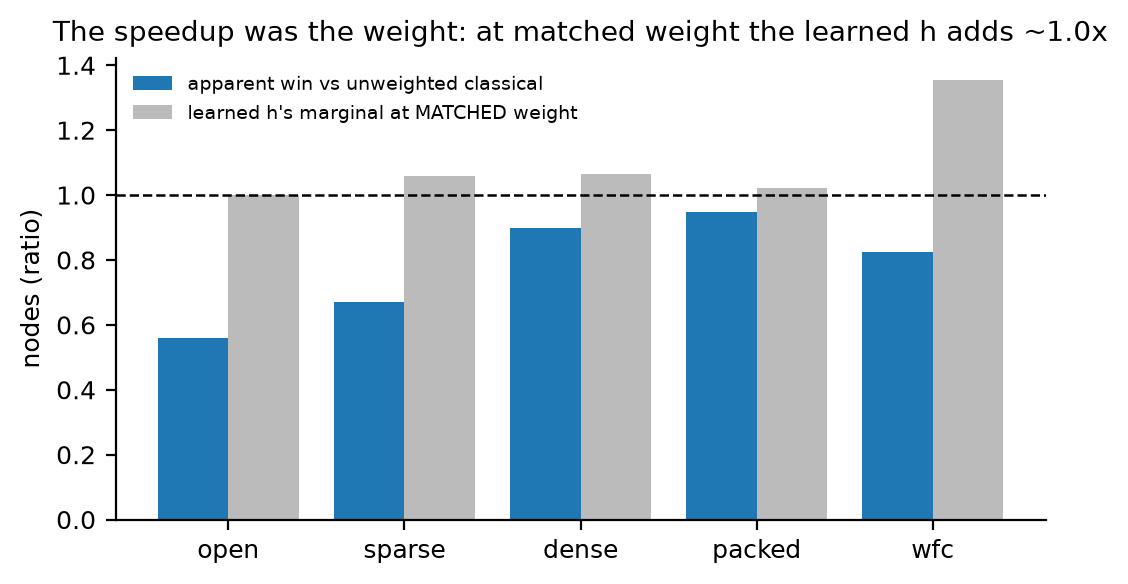
The negative is informative rather than terminal: it relocates the question from "does learning help?" to "what property of a model reduces error against a tight heuristic?" — the question Theorem 3's second corollary poses, and the subject of §4.2.
4.2 The wall is inductive bias, not learnability
Predicting distance-to-go on hard grid mazes, we fixed capacity and varied only the inductive bias. The local patch and a message-passing network of depth far beyond the graph diameter cannot reduce the error of a tight ALT heuristic; a differentiable relaxation — a Bellman–Ford recurrence implemented as the layer — crosses (Table 2, Figure 2).
| arm | inductive bias | held-out search vs the tight classical heuristic |
|---|---|---|
| local MLP (patch) | none | 1.42× (fails) |
| message passing, depth ≫ diameter | locality | 2.16× (fails) |
| differentiable relaxation | the algorithm is the layer | 0.93× (crosses) |
Table 2. The inductive-bias frontier (bias_frontier.json, rows). Fixed capacity;
only the bias changes.
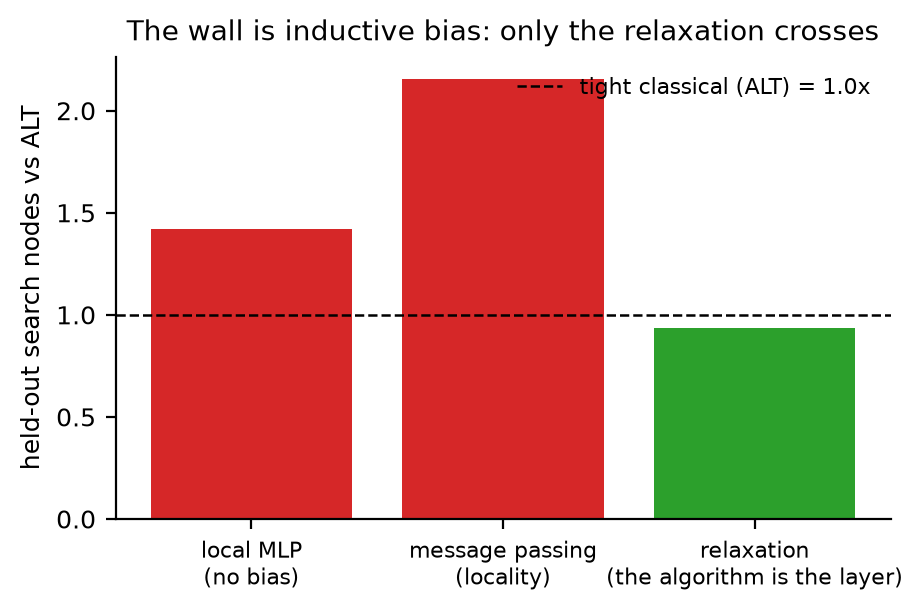
The wall the programme spent a chapter mapping is therefore not "global functions are unlearnable" but "not learnable by architectures whose inductive bias is local" — a corollary of Theorem 3's second statement, now with a constructive witness.
4.3 And it scales
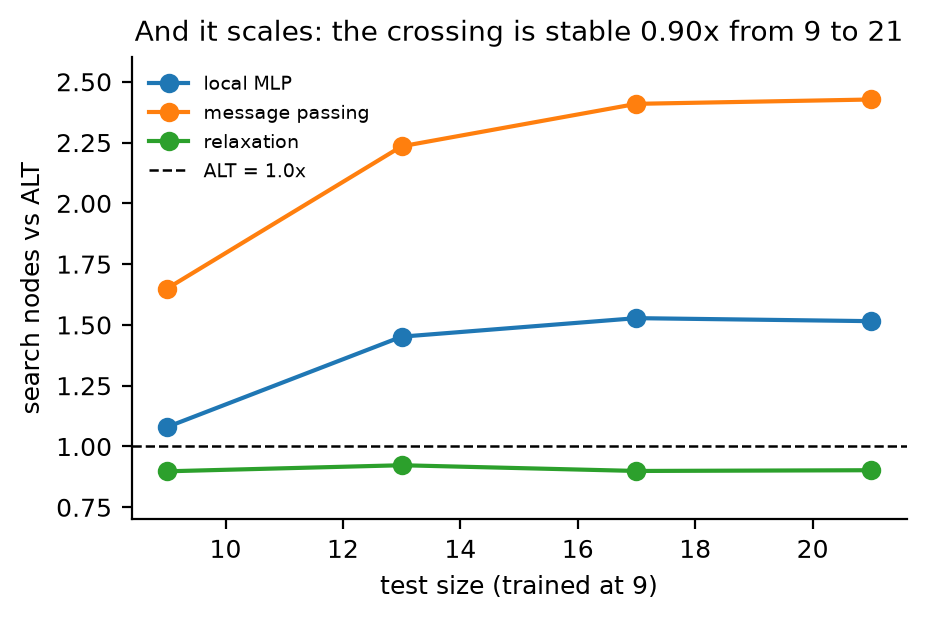
A crossing that appears only in a small regime is a curiosity. Trained once at size 9 and tested at 9, 13, 17, and 21, the relaxation arm crosses at every size, holding $\approx 0.90\times$ ALT, while the local and message-passing arms degrade monotonically (Table 3, Figure 3). The learned seed transfers and the bias scales with the problem: the crossing is a method, not an accident of the small regime.
| test size | local MLP | message passing | relaxation |
|---|---|---|---|
| 9 (trained here) | 1.080 | 1.649 | 0.898 |
| 13 | 1.452 | 2.235 | 0.923 |
| 17 | 1.528 | 2.409 | 0.899 |
| 21 | 1.515 | 2.427 | 0.902 |
Table 3. Crossing generalization (crossing_generalization.json).
4.4 And the bias must match the predicate
If an algorithmic bias were sufficient in the abstract, the relaxation that crossed distance-to-go should cross any global predicate. It does not. On a second predicate — reach the goal through a designated waypoint — the plain relaxation fails at $1.58\times$, while a relaxation rebuilt for that predicate (seeded at the waypoint and the goal, combined through the predicate) crosses at $0.96\times$ (Table 4, Figure 4). The falsifier for a universal bias is measured, and it fails.
| arm | inductive bias | vs the tight constrained ALT |
|---|---|---|
| local MLP (patch) | none | 2.043× (fails) |
| message passing | locality | 2.910× (fails) |
| plain relaxation | distance-to-go | 1.584× (fails) |
| predicate-matching relaxation | seeded at w and g | 0.957× (crosses) |
Table 4. The predicate axis (predicate_axis.json). The same relaxation that crosses
distance-to-go fails the constrained predicate until its bias is rebuilt.
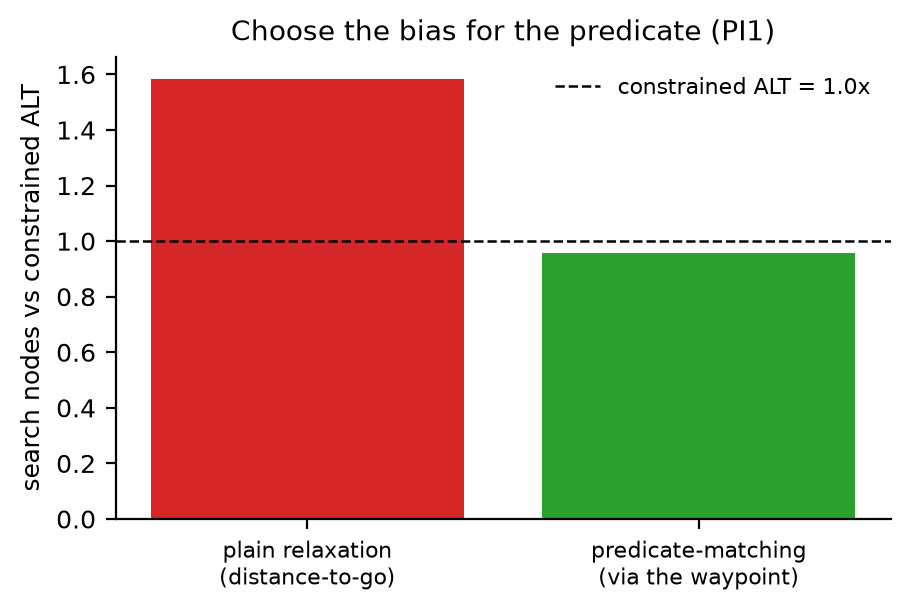
This is the sharpest of the results: it converts "the bias matters" into "the bias must match the predicate," a methodology rather than a curiosity.
4.5 And the regime decides when matching helps
The theorem's part (iii) says matching is a property of the triple $(\mathcal H, P, R)$ — the evidence regime — because $h^\*_P$ can be global in one regime and local in another. Until now that component was asserted, not measured. The safety substrate's search problem provides the test: the certified search over discrete driving maneuvers, where the classical baseline is the hand-coded speed-first order and the predicate is collision-freedom under the authority's kinematics. Three orderings, scored at identical decision states (paired): classical (speed-first), matching (a relaxation ranked by predicted clearance under the authority's own dynamics), and local (a frozen-leader gap model that ignores closing speed — a plausible bias that does not match the predicate).
The registered claim — matching crosses the f-contour at $\le 1.0\times$ classical where local does not — fails on the aggregate: local fails to cross as predicted ($1.20\times$), matching clearly beats local ($1.42$ vs $1.67$ mean expansions), but matching misses the bar at $1.02\times$ classical. Reported, not moved. The per-cell measurement then explains the failure. Sweeping all seven scenarios × five densities and recording, for each cell, the FASTER-admissibility — the fraction of decision states where classical's first candidate certifies — the classical−matching gap tracks $1 - \text{admissibility}$ at $\rho = +0.79$ (cell) and $+0.79$ (scenario aggregate). Where the regime makes a predicate-blind bias optimal (roundabout, 97% admissible), the matching relaxation is pure overhead ($+1.55$ expansions); where it does not (highway, 36%), matching wins decisively ($-0.63$). The aggregate that failed simply averaged opposing regimes.
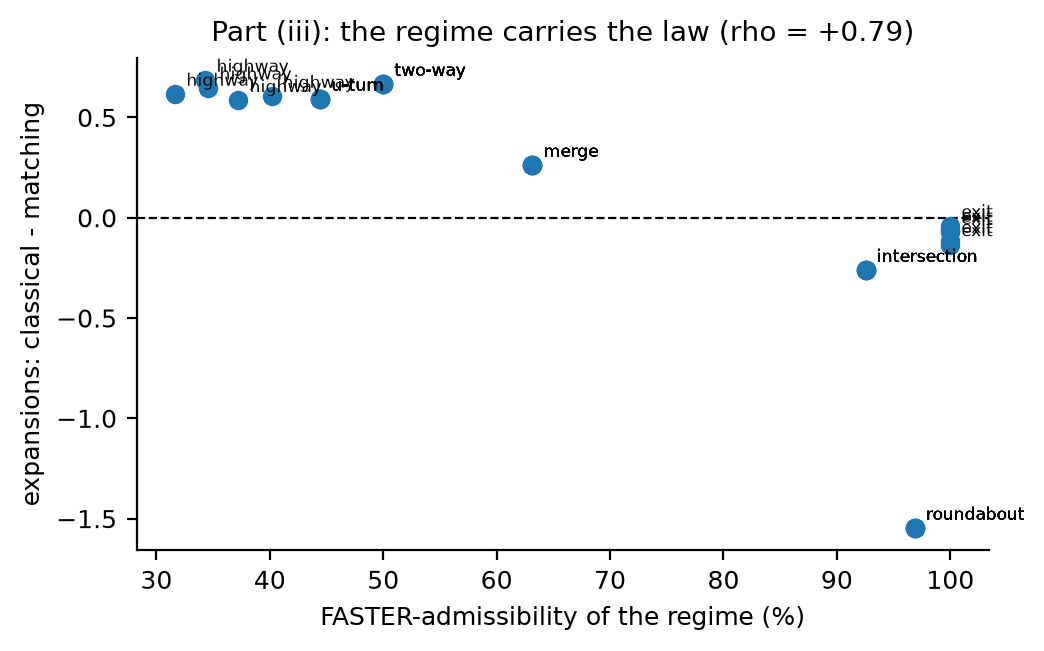
This is the necessity result for part (iii), not merely consistency: without the regime in the theorem, the (architecture, predicate)-only law is false on this substrate's own data — the same bias that must match the predicate (§4.4) can only show its gain where the regime leaves it something to fix. The design rule therefore refines to: choose the bias for the predicate, in the regime you will run in — and the regime is measured, not assumed.
5. The law, and what it hands to practice
The findings above are one law. Make the predicate explicit: for a task predicate $P$ with value function $h^\*_P$, a heuristic class $\mathcal H$ matches $P$ at error $\varepsilon$ if it contains a member with relative error $\le\varepsilon$ against $h^\*_P$.
Theorem 4 (Bias–predicate matching). Let $h_c$ be a classical admissible heuristic for $P$ with error $\varepsilon_c$. (i) If $\mathcal H$ matches $P$ at $\varepsilon\le\varepsilon_c$, the certified search with that member expands no more nodes than with $h_c$ — and if $\mathcal H$ contains a monotone transform of $h^\*_P$ (error 0), it expands the minimum. (ii) If $\mathcal H$ misses $P$ at $\varepsilon_0>\varepsilon_c$, no member expands fewer nodes than $h_c$. (iii) Matching is a property of the triple $(\mathcal H,P,R)$ — the predicate's evidence regime $R$ — because $h^\*_P$ can be global in one regime and local in another.
Theorem 4 is Theorem 3 generalized to an arbitrary predicate, with part (iii) explaining why the same bias can match one predicate and miss another. Part (iii) is no longer only asserted: §4.5 measures the regime axis on a second substrate and shows it is load-bearing — drop $R$ and the law is falsified by its own aggregate. Its practical content is a method for localizing a ceiling — change one axis, watch which one the ceiling moves with — and the design rule it hands to practice is one sentence: choose the bias for the predicate, in the regime you will run in.
6. Limitations and open problems
The theorems are exact under their assumptions; the empirical content rests on a maze substrate and a handful of predicates — with one second substrate (continuous traffic) for the regime axis alone (§4.5) — so the scope of "matches" is a question, not a result. Three items are open.
The characterization of matching. Theorem 4 makes matching sufficient and necessary given the error comparison, so the open problem is to predict that comparison from the structure of $\mathcal H$ and the predicate's computation. Our instances are the first data points — local and message-passing classes miss global predicates at every scale; a relaxation that is the predicate's recurrence matches. The falsifier is a single counterexample: an $\mathcal H$ that crosses $P$ while missing $P$'s computation.
The regime index. Part (iii) makes matching depend on $R$, but we have only measured two regimes (the high- and low-observation limits of a witness predicate elsewhere in the programme). A systematic map of $R$ is missing.
Scope. We do not claim that no learned heuristic can reduce error — the relaxation shows one can. We claim only that it must reduce error to speed a search, that such a reduction is a learnability question set by the model's inductive bias, and that the bias must match the predicate being asked of it.
7. Conclusion
The safety of a verification-centric system is structural and free; its efficiency is not. The price of certification is the volume of the f-contour, and a learned heuristic pays only by reducing error (Thm 3). Measured honestly, an apparent accelerator was the weight; measured with the right bias, a differentiable relaxation crosses the tight classical heuristic at $0.93\times$, holds $\approx 0.90\times$ under scale, and crosses a second predicate only when its bias is rebuilt for it. The general statement (Thm 4) turns this into a methodology — choose the bias for the predicate — and a single open problem: characterize which classes match which predicates in which regimes.
References
[1] E. P. Denadai. Containment Rather Than Calibration: A Sound Architecture for Learning Under Partial Observability. Optimality.ai, 2026.
[2] E. P. Denadai. Exact-Authority Belief-Space Planning: Where Composition Emerges and Where It Fails. Optimality.ai, 2026.
[3] E. P. Denadai. Learnable Boundaries, Unlearnable Competence: A Characterization of Learned Components in a Symbolic Search Stack. Optimality.ai, 2026.
8. Provenance
Every empirical claim is reproduced from the isolated subsystems
../../certified_heuristic/, ../../expressivity_bound/, and — for §4.5 —
../../env_substrates/highway/; the figures and tables are
generated verbatim from their artifacts by make_figures.py
(nothing hard-coded): Table 1 and Figure 1 from control_ch_mg.json (slack_law.frontier);
Table 3 and Figure 3 from crossing_generalization.json; Table 4 and Figure 4 from
predicate_axis.json; Table 2 and Figure 2 from bias_frontier.json; Figure 5 and §4.5's
numbers from the highway substrate's bias_regime.json (bars H-6/H-6-D registered in
env_substrates/highway/docs/PLAN.md before the runs; H-6's crossing FAIL is reported
where it occurred). Containment and the
witness results live in ../../minigrid_refit/ and ../paper_model_free/,
../paper_model_based/. Bars and falsifiers were registered before each run; the failed
bars are reported where they occurred (§4.1 in particular).