Abstract
A reactive policy, however safe, is total over the states it has seen: it cannot compose a sequence of conditions and it cannot enter a layout it has never mapped. This paper is the story of replacing that reactive proposer with a search over a belief — and of the two things that storytelling forced us to discover. Learning to compose worked, and it worked emergently: deleting the hand-written orchestrator and searching the joint belief state reproduced the key$\to$door$\to$goal ordering as a consequence of the physics, an ablation collapsing the planner to $0.000$ when the rule was removed, and a contrastive ranker lifting novel-layout success from a reactive $0.107$ to $\mathbf{1.000}$ while cutting search nodes $6.7\times$ emphasised at two. Learning to be robust to perturbation split cleanly in two — and the split, not either half, is the finding. An observation-grounded belief absorbs a shock that removes a requirement (a naive planner still scores $1.000$) because the next observation reveals the new reality; but it is brittle to a shock that blocks an expected transition (naive $0.000$, a $600$-step loop, because the agent observes the same closed door and re-predicts the same lost transition forever). Escaping required an explicit Epistemic Divergence Monitor that detects the falsification and mutates the search graph — and a principle we came to call the agent's curiosity is bounded by its own falsifications. Along the way we proved the loop-contraction and containment properties that make the whole thing safe for an arbitrary proposer, and we carried the sharpest negative — the frozen decidability map is inert where success is concerned — to a second, independent implementation that reproduced it on real MiniGrid.
1. Introduction: composition as the missing capability
We begin where the reactive companion chapter ended. Its $\Omega$-TD proposer is contained — four hard guardrails, zero-violation safety — but it is a total decision function over observed states: it decides each step from the state in front of it. That leaves two failures open, and they are not small. Composition: a certified path is a conjunction of conditions (hold a key and open the door and reach the goal), and a reactive map has no place to put the "and". Out-of-distribution traversal: states are observation-keyed, so every novel layout is a cold start.
The model-based answer we pursued keeps the containment architecture and the exact evidence channels exactly as they are, and replaces only the proposer — with a search over a belief state $b_t$. The belief is the paper's first substantive idea, and it comes with a doctrine that dictates everything after it.
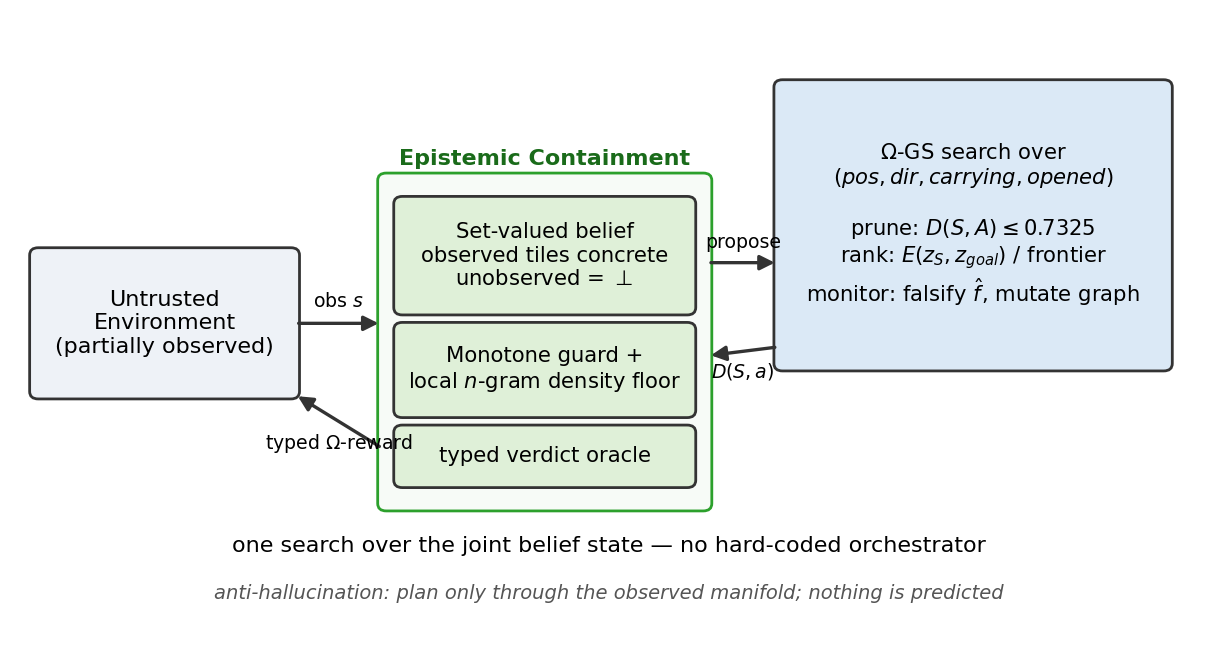
2. The containment doctrine and its consequence
The doctrine is small enough to state in a sentence: learn only what is not
analytically known, and represent what is not observed as a set, not a point. The
belief exposes observed tiles as concrete and everything else as $\bot$; pose
transitions are analytic (LEFT/RIGHT rotate, FORWARD moves only if the front cell
is observed-passable); observation is a union. Nothing is predicted, so nothing
compounds over a horizon, and the out-of-distribution condition becomes structural:
a state is OOD exactly when it asserts an unobserved tile.
That doctrine has a sharp consequence, and it is the paper's central finding — though we did not see it until the ontology was stressed (§7). A belief grounded in observation is robust to shocks that remove a requirement, because the next observation simply shows the new reality, and it is fragile to shocks that block an expected transition, because the agent observes the same unchanged world, re-derives the same failed plan, and loops. We state it now as Proposition 3; we discovered it by building the shock that tests it.
3. Belief representation and the exact search
We keep the provenance of every number honest: the belief is anchored in the agent's own
frame, and the map from image cell to world offset is recovered by replicating
MiniGrid's own pipeline (the get_view_exts slice followed by rotate_left applied
direction+1 times), which we verified pixel-exact against the true grid on visible
cells (792/792 over 40 seeds) and exact under arbitrary action sequences
(710/710 rollouts). Blocked FORWARD is decidable from the pre-action observation
alone — the front tile is always rendered at image cell (3,5) — so wall-blocking needs
no ground truth and no dead-reckoning, and no environment ground truth is read anywhere.
Over this belief we unroll one Dijkstra/BFS. Pruning is exact (a branch whose frozen
read $D(\text{rendered},a)\le0.7325$ is cut), halting is exact (a FORWARD through an
unobserved cell is never expanded), and ranking is soft (a contrastive energy in the
GoToObj setting, a coverage frontier elsewhere). The planner returns the root action of
the best path — or abstains. The search reads the frozen map read-only: mental
rollouts write nothing; only physical execution may mint evidence.
4. Composition is emergent from belief and search
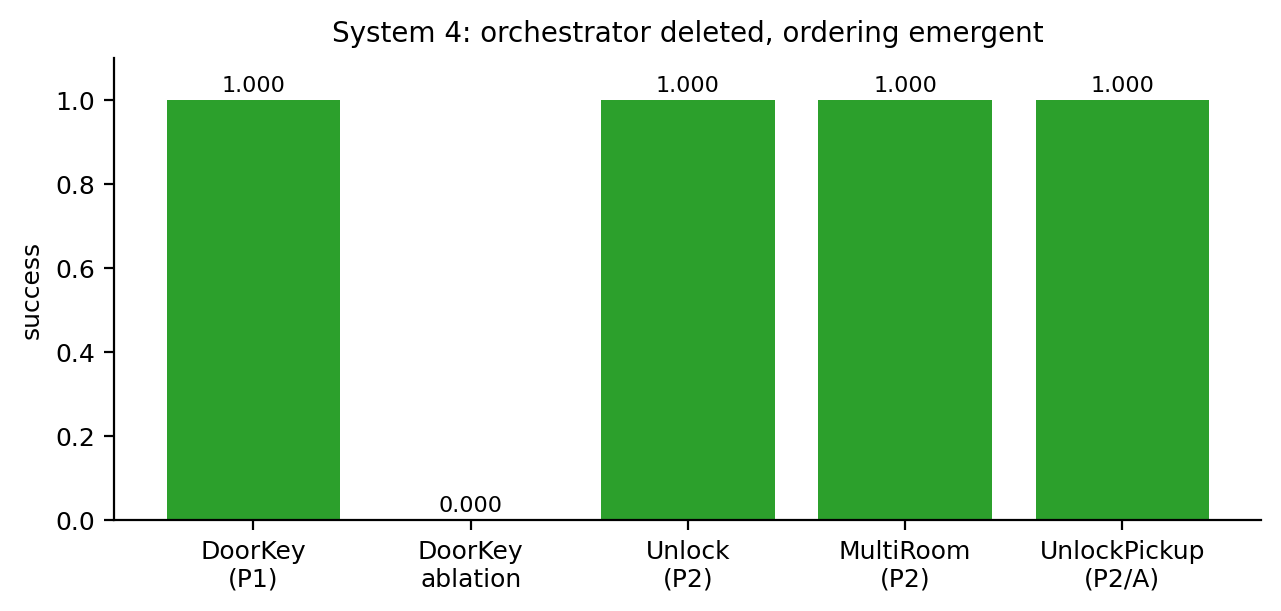
A small amount of hand-written structure sufficed. We deleted the orchestrator
— the if key / elif door / else — and replaced it with one search over the joint state
and a single goal predicate. Composition emerged. The decisive test is an ablation:
delete the rule that a locked door blocks, and the planner walks straight through it,
ignores the key, and fails — $1.000\to0.000$ (Fig. 5). The key$\to$door$\to$goal
ordering is a consequence of the dynamics, not smuggled in.
The same file then solved DoorKey, Unlock, MultiRoom and UnlockPickup, differing only in
the model (dynamics + goal predicate, all $1.000$); a parser mapped the mission
string to {target, predicate} and deleted the per-task goal flag ($1.000$, parser
15/15 paraphrases); and adding DROP made the full
Empty→Full→Empty→Full inventory cycle expressible (UnlockPickup $1.000$).
| claim | result |
|---|---|
| P1 orchestrator deleted (unified search) | DoorKey 1.000 |
P1 dynamics ablation (door_blocks=False) |
0.000 (collapse) |
| P1 interleaving (goal closer than key, behind door) | PASS (walks away from goal, 37 steps) |
| P2 same file across tasks | DoorKey / Unlock / MultiRoom / UnlockPickup 1.000 |
| P3 goal from parsed mission | 1.000; parser 15/15 paraphrases |
| Phase A: DROP $\to$ full inventory cycle | UnlockPickup 1.000 |
5. The proposer as a control problem
On novel layouts the reactive map scores $0.107$. The belief-space search lifts that to $0.825$ with the frozen prior, and to $1.000$ with a contrastive relevance ranker — zero new gradient steps, the search running entirely in-silico (Fig. 2).
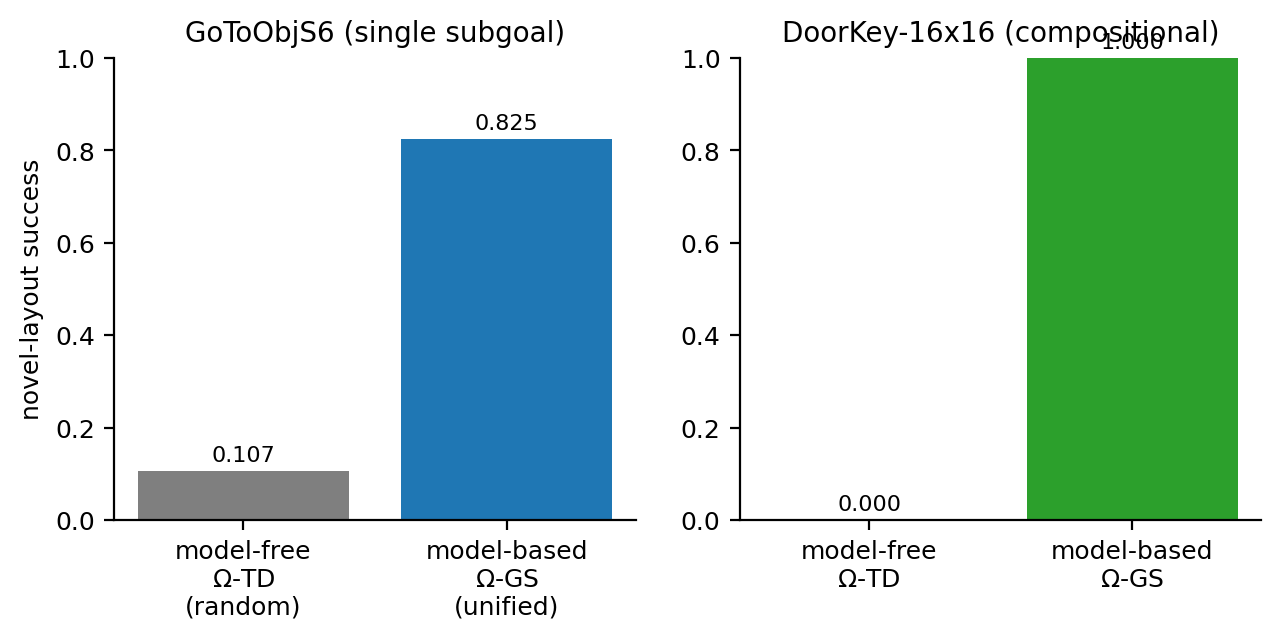
| agent | novel-layout success |
|---|---|
| model-free $\Omega$-TD (reactive) | 0.107 |
| model-based $\Omega$-GS (frozen $D$ prior) | 0.825 |
| model-based $\Omega$-GS (contrastive ranker) | 1.000 |
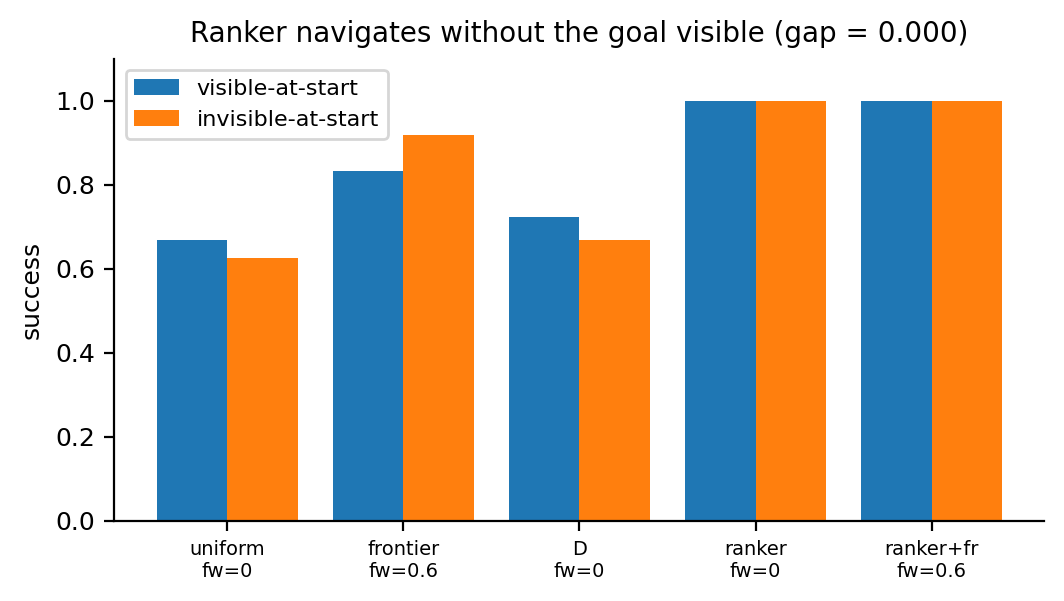
But a good headline hides the interesting part, which is what is actually doing the work. We ablated the proposer into pieces (Fig. 3), and the controls told us something uncomfortable: the frozen decidability map $D$ is inert on novel layouts ($\Delta=-0.025$; $85\%$ of q-values at initialization) — the honest negative — whereas the ranker is load-bearing ($\Delta=+0.375$ over the hand-coded frontier heuristic, at a $6.7\times$ node reduction). The controls held: oracle-leak leak-free ($66.7\%$ belief dependence), the firewall intact ($\Delta\text{weights}=0$), and a hallucination veto at $0.00\%$.
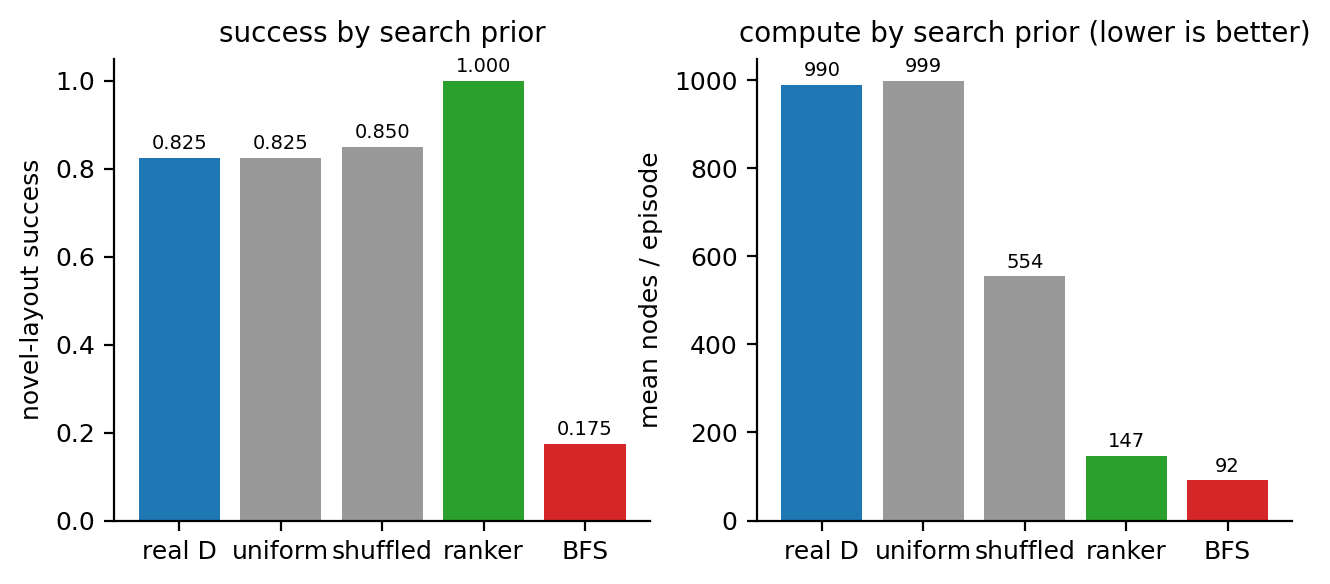
| arm | success | nodes / episode |
|---|---|---|
| real $D$, frontier | 0.825 | 989.7 |
| uniform prior | 0.825 | 998.9 |
| shuffled prior | 0.850 | 554.4 |
| ranker | 1.000 | 146.8 |
| BFS baseline | 0.175 | 91.5 |
Then we turned our own best result over. Is the ranker a navigation gradient, or a visibility detector in disguise? Restricting the probe to goal-invisible states: score std $0.072$ (non-flat), Spearman(score, $-$distance) $+0.238$, path-relevance AUC $0.654$. The ranker navigates — but weakly per-step; the episode-level $1.000$ compounds a weak gradient through closed-loop search (Fig. 7). We say so, because a $1.000$ that hides a weak per-step signal is exactly the kind of number this programme refuses to over-read.
6. Event-triggered planning under belief change
Deliberation is a sledgehammer for a fully observed hallway, so we built a gate that re-plans only when the plan's premise changes — no plan, exhausted, sub-goal moved, fog, or boundary — and otherwise executes the cached action in $O(1)$. On DoorKey this cut search nodes by $80\%$ ($5000.4\to1001.9$) at identical $1.000$ success. It missed our $85\%$ bar, and the failure taught us why: DoorKey is exploration-dominated, so re-plan frequency has an information-theoretic floor, and no gate can go below it. The falsification control flagged the miss correctly (Fig. 4).
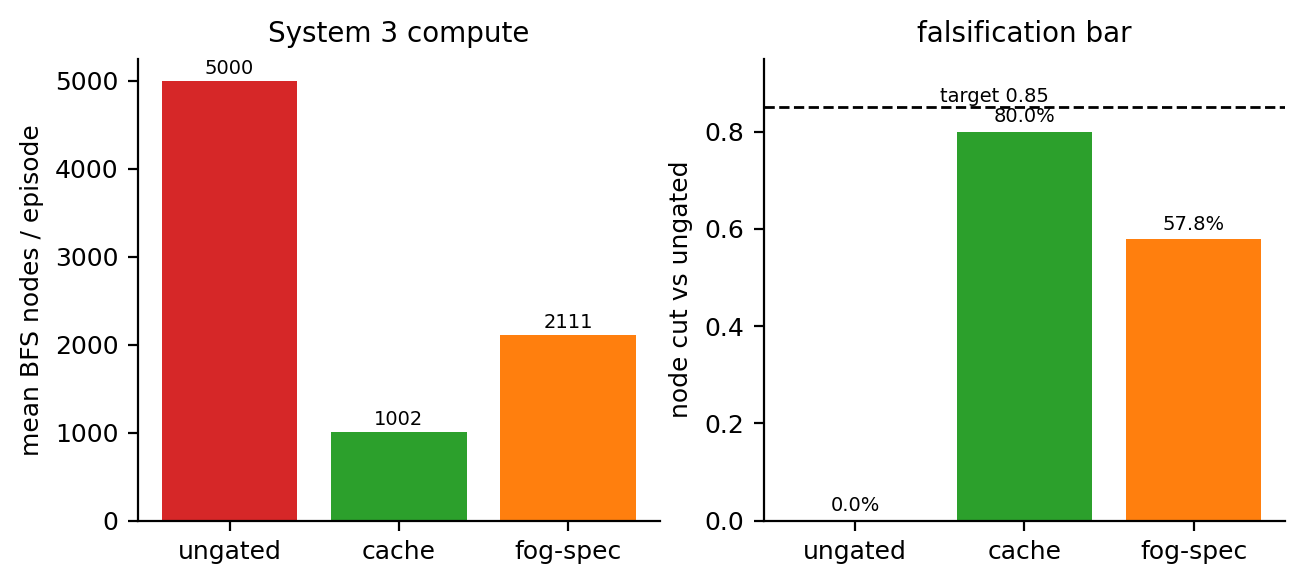
| mode | success | nodes | cut |
|---|---|---|---|
| ungated (replan every step) | 1.000 | 5000.4 | — |
| cache (plan-validity) | 1.000 | 1001.9 | 80.0% |
| fog-spec (conf$<0.85$) | 1.000 | 2110.6 | 57.8% |
7. Two negative results and the boundary between them
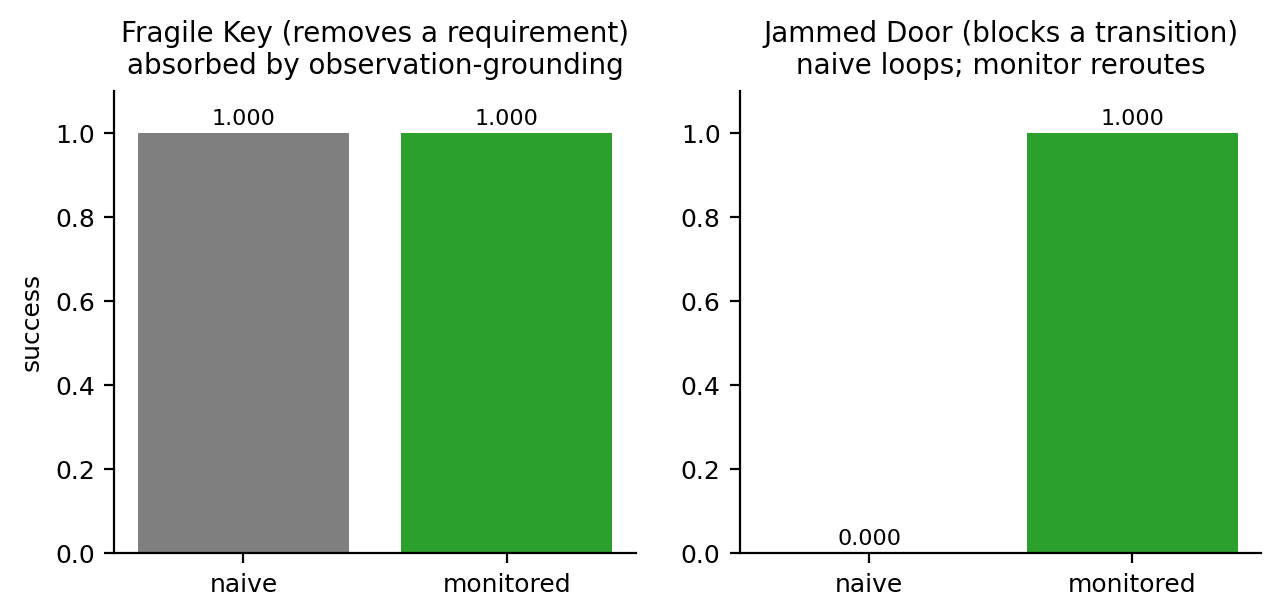
Everything above assumes the world obeys the model. The paper's sharpest experiment asks what happens when it does not, and it splits the answer cleanly (Fig. 6).
| shock | naive | monitored |
|---|---|---|
| Fragile Key (removes a requirement) | 1.000 | 1.000 (divergences 50/50) |
| Jammed Door (blocks an expected transition) | 0.000 (600-step loop) | 1.000 (59 steps) |
Fragile Key removes a requirement. The naive planner is fine ($1.000$) — observation-grounding absorbs the shock, because the next observation reveals it.
Jammed Door blocks an expected transition. The naive planner is brittle:
it observes CLOSED, predicts TOGGLE$\,\to\,$OPEN, the environment ignores it, and it
loops forever — $0/50$, a $600$-step loop. We had, in effect, rediscovered Proposition 3
the hard way. The escape required building the thing the doctrine lacked: an Epistemic
Divergence Monitor that, every step, compares prediction to observation, and on
divergence records the empirical effect and mutates the search graph — marks the tile
empirically impassable (jammed), rewrites the action's carrying effect, and forces a
re-plan on reality. The search then natively routes the long path around ($1.000$, 59
steps). One detail turned out to be critical and is worth naming: the exploration
affordance must respect the jammed ledger, or the "closed door is actionable" rule
re-toggles it — the agent's curiosity is bounded by its own falsifications.
8. Falsification as method, and the seam to distillation
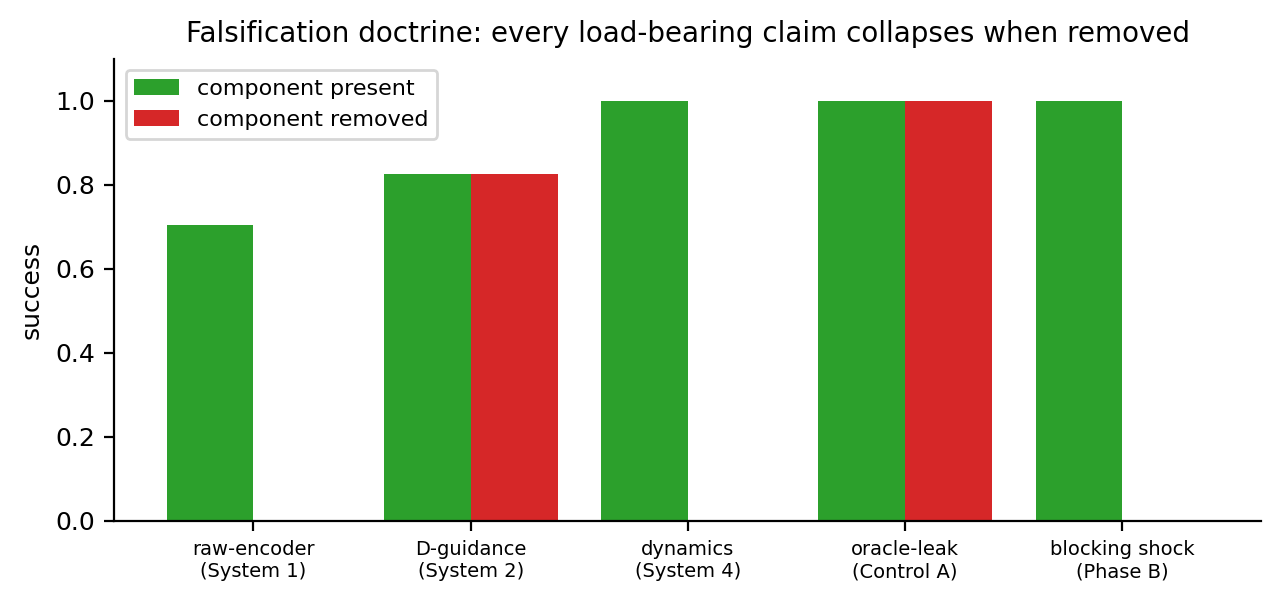
We do not trust any of the above unless removing the load-bearing component breaks it. Every capability claim was paired with a control that collapses (Fig. 8) — and one cell of that matrix, the frozen map, does not collapse but is inert, which we report with the same prominence as a success.
| claim | control | expected collapse |
|---|---|---|
| tile encoder suffices | raw-encoder control | raw $0.000\to$ spectral $0.703$ |
| $D$ guides search | uniform/shuffled prior | identical success ($D$ inert) |
| ranker is load-bearing | frontier-only baseline | $1.000\to0.825$ |
| composition is emergent | door_blocks=False |
$1.000\to0.000$ |
| search uses the belief | oracle-leak corruption | leak-free |
| mental rollouts write nothing | firewall fingerprint | $\Delta$weights $=0$ |
| monitor rescues blocking shocks | naive vs monitored | $0.000\to1.000$ |
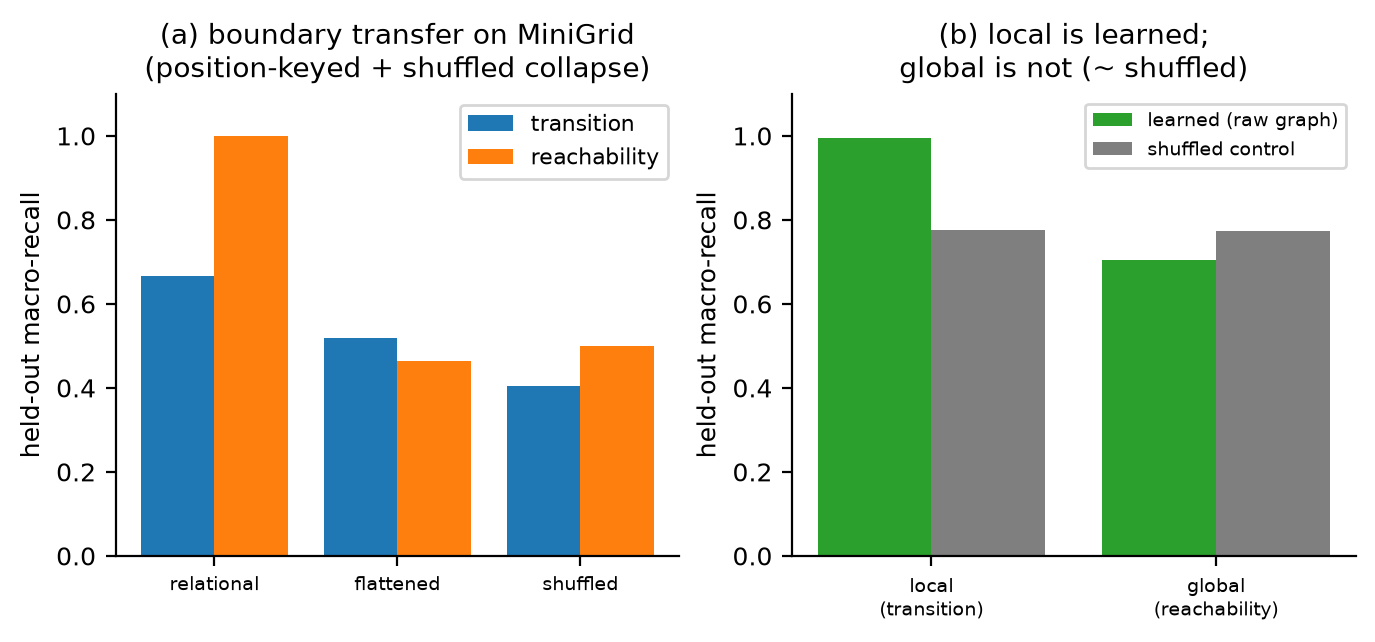
That inertness cell then became a paper of its own. We carried the question to a second,
independent implementation — the $\Omega$-bel authority, re-instantiated symbolically,
labelled in-silico, and re-run on real MiniGrid after certifying that the first
hand-built substrate was not MiniGrid-faithful. It asked the inverse question: if the
boundary cannot be searched into existence, can it be learned — and does it buy
capability? The instruments: the oracle target is a function of the belief (ceiling
$1.000$); the ground-truth collision ceiling — the leak bound — is $1.000$ on MiniGrid,
because the forward view always observes the front cell; the decidability share is
$P(R_1)=0.293$. The boundary distills and transfers ($1.000$ relational, controls
collapsing), and the witness kind is perfectly distillable ($1.000$) yet redundant for
the class — naming the missing witness is the product, not an accuracy instrument. But
the prior is inert on top of the exact search: on MiniGrid a belief-space planner
lifts success over reactive ($0.360\to0.733$ dense; $0.650\to0.760$ held-out) and
search+prior is identical to the digit ($85/85$ nodes). The old subset's
"topological shield" does not reproduce — with the front always observed the reactive
policy already incurs $0.0$ violations, so there is nothing to shield. The map is a
veto; the planner is the engine of competence.
| distillation quantity (real MiniGrid) | value |
|---|---|
| oracle-target ceiling | $1.000$ (labels are a function of the belief) |
| ground-truth collision ceiling (leak bound) | $1.000$ (front always observed; world probe not flagged) |
| decidability share $P(R_1)$ | $0.293$ |
| boundary transfer, relational (held-out) | reachability $1.000$; transition acc $1.000$ (macroR $0.667$, $R_1$ absent) |
| boundary transfer, flattened / shuffled | transition $0.519$ / $0.404$; reachability $0.465$ / $0.500$ |
| witness kind: distillable / redundant-for-class | $1.000$ / yes |
| success, reactive $\to$ search $\to$ search$+$prior (dense / held-out) | $0.360\to0.733\to0.733$ / $0.650\to0.760\to0.760$ (prior inert) |
9. What is proved
The narrative has a spine of guarantees, and they are what make a learned proposer — even a search — safe to place inside the loop. Containment extends to a search unchanged: under invariants I1–I4, for any proposer, the executed action is guard-allowed or an abstention, so no update to the proposer causes an unsafe execution (Theorem 3). Uncertified cycles contract to the refutation anchor $V^\star=-1.0$ (Lemma 1). Anti-hallucination is sound: a search that expands only through observed-passable cells never plans through unwitnessed geometry (Proposition 2). And the blocking-shock behaviour is not a bug but a theorem: an observation-grounded planner that re-plans from an unchanged belief will re-propose a blocked transition indefinitely, so escaping it requires mutating the model (Proposition 3 — the algebraic form of the Jammed-Door result). Proofs are collected in Appendix A.
10. Conclusion and open problems
Composition can be emergent. Deleting the orchestrator and searching the joint state reproduces the ordering, and the ablation proves it did not survive by accident. Goals can be declarative, parsed from language. The physics model can be falsified and rewritten mid-task. And the boundary between the two shocks is the central finding: observation-grounding absorbs shocks that remove a requirement and is fatal to shocks that block one, because the agent re-predicts the same lost transition from the same unchanged belief until something — a monitor — mutates the graph.
We are careful about what is not shown. The ranker is only weakly per-step-navigational (path-relevance AUC $0.654$); the $1.000$ is a closed-loop compounding of a weak gradient. The Divergence Monitor is a principled rule-override, not a general axiom-rewriting engine. The parser is a regex — P3 relocates the hardcode from code to language, it does not eliminate human specification. UnlockPickup costs $\sim$80k search nodes, so efficiency, not only success, remains open. And every experiment is a MiniGrid gridworld: the claims are architectural, and extending them to physical systems would require a physically-grounded latent belief, a density floor on that latent, and a real-time monitor budget — none demonstrated here.
References
[1] E. P. Denadai. Containment Rather Than Calibration: A Sound Architecture for Learning Under Partial Observability (the model-free companion). Optimality.ai, 2026.
[2] M. Alshiekh et al. Safe reinforcement learning via shielding. AAAI, 2018.
[3] D. Dalal et al. Safe exploration in continuous action spaces. arXiv:1801.08757, 2018.
[4] L. Sha. Using simplicity to control complexity. IEEE Software, 2001.
[5] A. D. Ames et al. Control barrier functions. ECC, 2019.
[6] C. K. Chow. On optimum recognition error and reject tradeoff. IEEE Trans. IT, 1970.
[7] E. P. Denadai. $\Omega$-Certifiability: A Theory of Certified Ignorance. Optimality.ai, 2026.
[8] E. P. Denadai. Reinforcement Learning from Verifiable Feedback. Optimality.ai, 2026.
[9] E. P. Denadai. Fail-Closed LLM. Optimality.ai, 2026.
[10] E. P. Denadai. Knowing When Not to Act. Optimality.ai, 2026.
[11] E. P. Denadai. Monotone Guardrails. Optimality.ai, 2026.
[12] P. Auer et al. Finite-time analysis of the multiarmed bandit problem. Machine Learning, 2002.
[13] M. G. Bellemare et al. Unifying count-based exploration and intrinsic motivation. NeurIPS, 2016.
[14] T. Schaul et al. Prioritized experience replay. ICLR, 2016.
[15] Y. LeCun. A path towards autonomous machine intelligence. 2022.
[16] Contrastive relevance ranker training. neuro_eigen/pretraining/README.md, 2026.
[17] M. Chevalier-Boisvert et al. BabyAI. ICLR, 2019.
[18] M. Chevalier-Boisvert et al. Minigrid & Miniworld. NeurIPS D&B, 2023.
Appendix A. Proof details
A.1 Theorem 3 (containment invariance). The selection set is
$\{a:\mathrm{guard}(s,a)=1\}\cup\{\text{Abstain}\}$ (I2, I4). $\mathrm{guard}$ is
parameter-free and independent of the proposer (I1); the density predicate is a function
of the observation alone (I3). A search proposer returns an action from that set (it
prunes with guard and the floor), so no update to the proposer — gradient or search —
enlarges the executable set. $\blacksquare$
A.2 Lemma 1 (loop contraction). Along an uncertified cycle, $V\leftarrow V+\alpha(\epsilon_r+\gamma_{\text{step}}V-V)$; the fixed point solves $V=\epsilon_r+\gamma_{\text{step}}V$, i.e. $V^\star=-1.0$; the error factor is $1-\alpha(1-\gamma_{\text{step}})$, a contraction for $0<\alpha<2/(1-\gamma_{\text{step}})$. $\blacksquare$
A.3 Proposition 2 (anti-hallucination soundness). A FORWARD transition is added to
the search only when the front cell is observed; by induction over the search tree,
every reachable state has all cells observed. Hence no plan routes through unwitnessed
geometry. $\blacksquare$
A.4 Proposition 3 (blocking-shock divergence). Let $(s,a)$ be an edge the model predicts to have effect $\varphi$ but the environment ignores. Executing $a$ leaves the environment unchanged: the next observation is identical, so $b_{t+1}=b_t$, the model is unchanged, and the planner re-derives the same plan and re-proposes $a$. The trajectory is periodic until timeout; escaping requires mutating $\hat f$. $\blacksquare$
A.5 Monitor mutation. On divergence the monitor records the empirical effect
(corrections[a], jammed.add(front)) and clears the cached plan; the search's
_passable returns False for jammed tiles and the exploration affordance also consults
jammed, so curiosity cannot re-propose the falsified transition. $\blacksquare$
Appendix B. Artifact provenance
cartographer/model_based/logs/{probe_ranker_ablation,probe_ranker_split}.json(§4–§5).cartographer/model_based/logs/gating_20261009_201311.log(§6).cartographer/model_based/logs/unified_20261010_100158.log(§4).cartographer/model_based/logs/ontological_20261010_112504.log(§7).cartographer/minigrid_refit/results/{control_c_mg,control_l1_mg,integrate_mg,pl1_mg}.jsonandcartographer/minigrid_parity/results/parity.json(§8, real MiniGrid);cartographer/oracle_distillation/results/*(subset — superseded for §8).
The model-free chapter (epistemic_map_v10.py) is imported read-only; the two chapters
are kept mathematically isolated.
Appendix C. Hyperparameters
| symbol | value | meaning |
|---|---|---|
| search budget | 100,000 nodes / call | per-replan BFS budget |
| prune bound | $0.7325$ | $D\le$ bound $\Rightarrow$ cut |
| gating fog threshold | $0.85$ | re-plan when local confidence $<$ |
| ranker | BERT-mini, InfoNCE | contrastive relevance, held-out AUC reported |
| monitor | per-step | predicted vs observed; mutate on divergence |